
Cherasco, snails in escargots from beyond the Alps
From next year, the Piedmontese plant will export meat and shells to specialised plants in France. Customers include 180 starred restaurants

3' min read
3' min read
Slowness is probably the only characteristic of the snail that the Heliculture Cluster of Cherasco does not exploit. The economy of the Piedmontese branded snail, in fact, runs fast: it aims to conquer the market in France and Spain and grows with fresh, ready-to-eat or frozen products for large-scale distribution. The Pole group - which includes the food business and the cosmetics research and development laboratories - has a turnover of EUR 5.5 million alone.
But the phenomenon goes far beyond Cherasco: in Italy, Metodo Cherasco farms have more than tripled in eight years, from 200 in 2016 to 967 in 2024.
The success is also the result of a specification developed in 2022 for the cultivation of snails. The numbers of the sector are impressive: it employs almost 12 thousand people and generates a turnover of almost 568 million euros, 15 times more than eight years ago (36 million). A market destined to grow further. Today, 90% of the demand is met by snails harvested in the wild between April and June, in countries that still allow this: Turkey, Poland, Lithuania and the Balkans. But in eight years' time, this will no longer be the case. Experts have calculated that there will be a shortage of around 100,000 tonnes of product in this timeframe due to climate change.
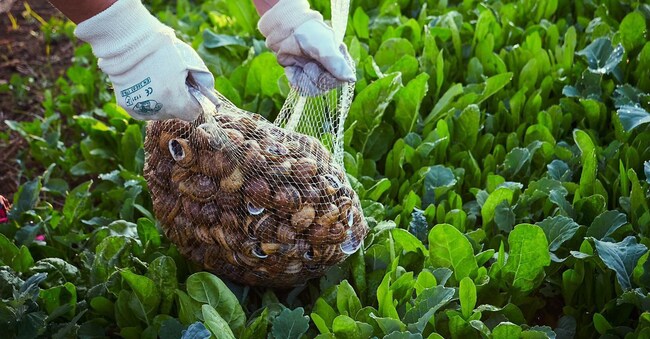
A country almost exclusively associated with harvesting in the wild is France. And it is here that Cherasco is preparing the attack starting in February. 'In 2026 we will export meat and shells to specialised plants in France, les escargots à la Bourguignonne will have our snails,' assures Simone Sampò, CEO of the International Heliculture Institute of Cherasco and of Lumacheria Italiana, a brand for food products and the main European snail meat processing centre. From the Piedmontese town, research has begun to develop a new market segment: products for large-scale distribution. An experiment that began with wholesale distributors and, for the past year, has been recalibrated with the 'Pronti al gusto' line with fresh, frozen and ready-to-use products destined for the counters of major supermarket chains. "Gourmet dishes, ready-to-use, traditional recipes but also the first 100% snail burger. The aim is to offer a product that tells stories of territory, passion but also discipline and a lot of innovation,' says Sampò. 87% of the product is still in demand in the catering industry, often at the highest level: Cherasco counts more than 180 starred restaurants among its customers to whom it supplies meat and shells. But even in large-scale distribution the signs are positive. A year and a half after the launch of the line for large-scale distribution, the turnover of 'Pronti al Gusto' is around EUR 650,000 a year, and growing steadily. In the supermarkets in Northern Italy, and progressively also in the centre, the weekly replenishment of products has reached 4000 pieces.
Today, the specification for the short natural cycle of snail cultivation - because, as the helicopter farmers explain, snails are cultivated and not bred - developed by the International Heliculture Institute of Cherasco in collaboration with the University of Gastronomic Sciences in Pollenzo, is active in 22 countries. The Cherasco Method is worth around 20 million invested abroad. The institute supplies the chicks born in its 'delivery rooms' to breeders who raise them following the strict diet dictated by the specifications. The final product can be harvested entirely by the Lumacheria as a meat processing centre. 'Controlling the supply chain allows us to have control over the taste of the meat, safer cultivation and lower harvest prices,' explains Sampò. Next to the gastronomy section, research and innovation in snail-related cosmetics is growing.

