
Art after Chernobyl: four decades of creativity and radioactivity
Forty years have passed since, in the early hours of 26 April 1986, reactor No. 4 at the Vladimir Il'ič Lenin nuclear power plant exploded in a chain of events whose scale, toxicity and duration still elude full comprehension. The disaster produced images that have become iconic: the abandoned Ferris wheel in Prypjat, empty classrooms, forests forced to absorb what the human body could not.
Forty years have passed since, in the early hours of 26 April 1986, reactor No. 4 of the Vladimir Il'ič Lenin nuclear power plant exploded in a chain of events whose scale, toxicity and duration still elude full comprehension. The disaster produced images that have become iconic: the abandoned Ferris wheel in Prypjat, empty classrooms, forests forced to absorb what the human body could not. But in reality, the real tragedy of Chernobyl is not contained in these scenes of desolation. It spread invisibly through air, soil, water, flesh and time. This is perhaps why artists have been returning to Chernobyl for decades: because the event far exceeds what the documentary image cannot say. Journalism reconstructs chronology; science measures contamination; history traces the origins and evolutions of political failures. But none of these languages restores what it means to embody a catastrophe whose most devastating force is rendered ungraspable across generations and species. Chernobyl thus poses a radical challenge to representation: it belongs to the register of the catastrophic sublime.
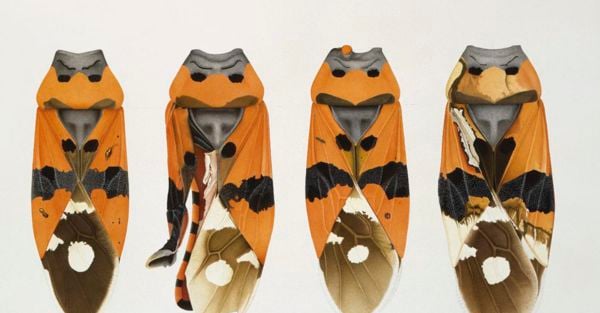
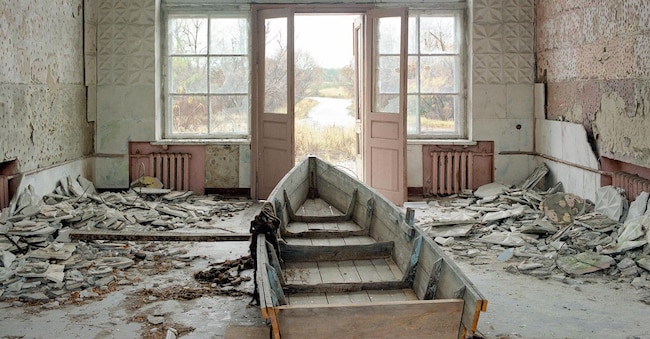
But its trauma lies in dissolving the boundaries between human and non-human, political and ecological, documentary and poetic. David McMillan's photographs of Prypjat trace the inexorable temporality of absence: by returning to the same places several times, the artist documents the crumbling of materiality. The initial ghostliness of suddenly abandoned buildings gradually gives way to a stripping away charged with existential resonances. More than a simple before-and-after, the work records a simultaneous material and spiritual disintegration embodied in the vulnerability behind everyday routines. Dealing with the precariousness of memory, Maxim Dondyuk has amassed a vast archive of photographs, letters, household objects. Memory survives in relics and fossils that confirm a lived past. The result is the perception of a trauma rooted not only in the landscape, but in the very intimacy of an undone everyday life, made up of hopes, smiles and intimacy, in Chernobyl as anywhere else in the world. The immeasurability of the trauma of Chernobyl prompted a redefinition of the relationship between space and experience. In Diana Thater's multifocal video installations, the exclusion zone appears as an emblematic landscape of the Anthropocene: a multi-species environment marked by toxicity, adaptation and precarious continuity. Far from suggesting that nature can simply undo the damage inflicted by humans, her fragmented landscapes weave resilience and vulnerability through the lens of stark, muted realism. Other artists have chosen to politicise schematic realism to give tangible form to the invisibility of radiation. Trained as an illustrator, Cornelia Hesse-Honegger moved away from the entomological ideal of perfection to focus on insects with deformed bodies gathered around the nuclear power plant. Her work dissolves the boundary between art and science, showing how entomological illustration can become an autonomous form of investigation. This synergy between art and science remains central in the Chernobyl Herbarium created by Anaïs Tondeur.
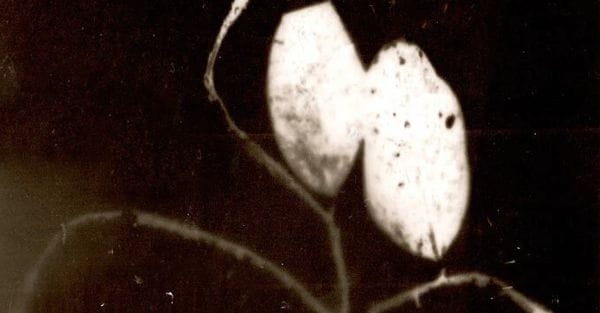
A series of stills of radioactive plants collected in the exclusion zone and developed in dialogue with the philosopher Michael Marder. The images evoke early 19th-century experiments in photography, but in this case, isotopes such as caesium-137 and strontium-90 help generate evanescent imprints, far removed from the sharpness of historical models. The result is a visual language that combines fragility with hope: living testimonies of toxic entanglements and warnings for the future. Through art, Chernobyl has become more than irreparably contaminated ecology. Roman Grygoriv and Illia Razumeiko have reinvented the disaster as an 'archaeological work', outlining a cultural and planetary condition of life after the collapse in an experimental theatrical form. Against the backdrop of industrial, religious and cultural ruins, the artists evoke a civilisation trying to remember and trace itself through rituals and emblems. These artists show that Chernobyl challenges images and at the same time makes them indispensable. Art shows how contamination continues to propagate not only in the environment, but also in the cultural imagination, leading us to invent new languages to give form to the invisible and the irretrievable. Chernobyl, in this sense, is not just a place or a date: it is rediscovering the sense of our humanity in a damaged world.

