
Chernobyl without electricity: are there risks?
The war brings frequent blackouts to the plant's power systems, while the sarcophagus of reactor 4 has been hit by drones. Are there dangers?

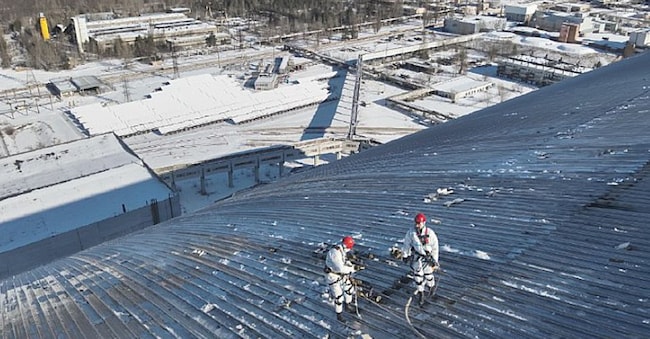
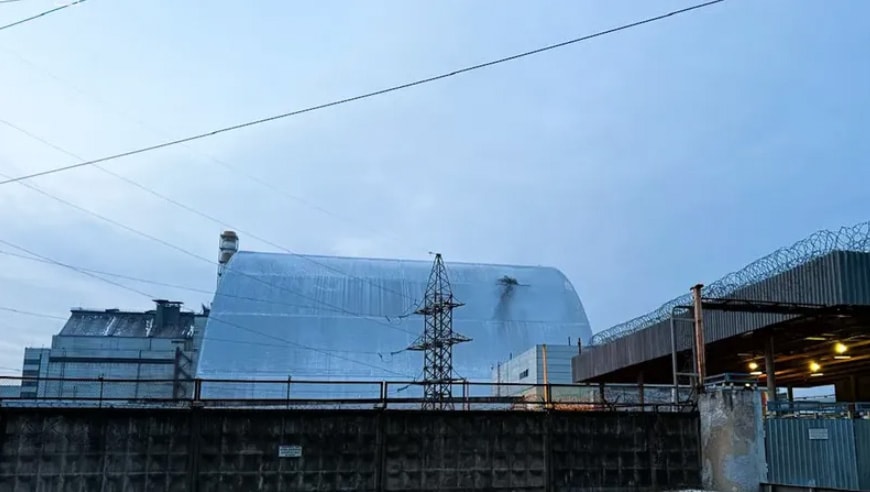
This is not the first time that the Chernobyl sarcophagus has been targeted by Russian attacks. Last February, 'a high-explosive warhead' had perforated the protective structure of reactor 4, the one from which the 1986 disaster started. This time it was not a missile directly at the sarcophagus, but at a very short distance, which cut off the power supply outside the plant.
In fact, the Director General of the International Atomic Energy Agency, Rafael Grossi, reported that several Ukrainian power substations were hit by a large-scale military attack. One of these was the Chernobyl nuclear power plant, which lost all external power supply, as well as several other power lines to other nuclear power plants. 'The IAEA is actively monitoring developments to assess the impact on nuclear safety,' Grossi added. This comes on the heels of a warning from Ukraine's military intelligence officers that Russian missile attacks against the country's power grid could lead to a 'second Chernobyl'.
Ukrainian experts say that the continuous bombardment of Vladimir Putin's army on the Ukrainian power grid has come close to nuclear reactors, some only 300 metres away from the Zaporizhzhia plant, which is very close to the front line. 'I am deeply concerned about the difficult situation at the Ukrainian nuclear power plants and the potential risks this poses to nuclear safety,' Grossi said.
As early as March 2022, when the Chernobyl site fell into the hands of the Russian invaders, there was a radioactive leak when the Russian military broke into the exclusion zone unprotected, stealing materials and disrupting the activities of the monitors. As a result of this intrusion, several Russian soldiers were exposed to radiation and suffered acute radiation syndrome, but with the retreat of the invaders, driven back by the Ukrainians at the end of March, the radioactive level around the plant had returned to normal.
Reactor 4 sarcophagus damage, blackout risks
The Chernobyl power plant comprises four decommissioned reactors and a radioactive waste disposal facility. The plant's last working reactor was shut down in 2000. Reactor number 4, where the disaster had erupted in 1986, was covered by a steel and concrete 'sarcophagus' completed by the Ukrainians in 2016, but the IAEA had previously warned that the protective shield could no longer properly contain radiation due to damage caused by a drone attack in February 2025. An inspection in December 2025 found that the structure had 'lost its main safety functions, including its confinement capacity'. Although repairs have been made, the site needs 'complete restoration' to 'prevent further degradation and ensure long-term nuclear safety,' Grossi said.

