
Chicks and clouds: do they also play at guessing shapes?
Giorgio Vallortigara in 'A spasso con il cane luna' starts from 'bestial' clues to discover more about what consciousness, intelligence, where memory lies

4' min read
4' min read
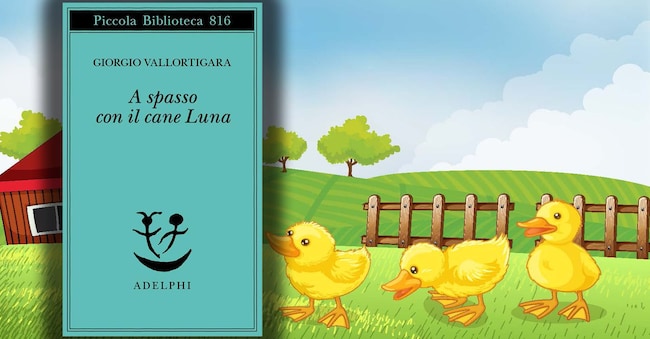
What if chicks also see faces in the clouds? Big chick faces? Giorgio Vallortigara, professor of neuroscience and animal cognition at the University of Trento, asks this question in A spasso con il cane Luna (Adelphi, pp. 222, €14), a little book full of surprises. Vallortigara is an old acquaintance of this journal: the first time his name appeared in it, in 2005, he was noted for having written an essay on the chicken brain, arguing that it was very useful for understanding the human brain. Indeed. And he displayed many feats of prowess, such as the ability to estimate the number of grains.
The second time, in 2007, we wrote about it because he had published a study on a philosopher fish. A small, colourful pinniped from Lake Tanganyika, the Astatotilapia burtoni, which - like Aristotle (remember the classic syllogism: 'All men are mortal, Socrates is a man, therefore Socrates is mortal'?) - knows how to make transitive inference: that is, to deduce an unknown relationship on the basis of knowledge of another relationship. In practice he can make this kind of inference: if Marcellus is taller than Claudius, and Claudius is taller than Luke, then Marcellus is taller than Luke. Not that the little fish really cares who the tallest person in the group is: he is more interested in finding out who - among his peers - hits the hardest, so as to save himself some unnecessary brawling.
After that second time, Vallortigara started writing directly in the "Domenica", and some of the articles published are collected in this small volume that - between the mind of a dachshund and the brain of a mathematician, between a prodigious unicellular blob and an altruistic chickadee - jumps with a lightness of a canary - sometimes with a few leaps of a grasshopper - between some of the most fascinating questions that sapiens have been asking themselves for millennia: what is intelligence? what is consciousness? who possesses it? is mathematics a language? do we think through language? why is someone altruistic? where is memory stored?
Reading it, we discover, for example, that looking for shapes in the clouds is really Vallortigara's pet project and has something to do with wolves, with dogs, with our need to tell stories. How? It starts with Alcibiades, a dachshund who with his master 'has woven an extraordinarily dense web of affection and mutual understanding'. Don't expect this to happen with a wolf cub: 15,000 years ago, the process of domestication began that changed not only the morphology, but also the mind of the grey wolf, making it much more capable of 'reading' the communicative signals of another species, ours. Domestication, writes Vallortigara, is a syndrome that seems to have rewarded those with a delay or heritable defect in the development of neural crest stem cells that has caused so many changes in former wolves: shortened muzzle, floppy ears, festive barking, wagging tails, neotenic (i.e. more puppy-like) traits, but also slower or immature development of the adrenal glands - glands that release stress hormones and serve to prepare the animal for fight and flight - making the dogs into docile sympathisers. On the other hand, even in very different animals such as zebra fish, an altered development of the neural crest - in this case artificially induced by making them transgenic - has a 'pacifying' effect: the little fish with the modified DNA were found to be much less anxious.
Harvard primatologist, Richard Wrangham, argues that a domestication mechanism similar to that which he exercised on the dog, humans would have turned it on themselves, making us less aggressive than our chimpanzee cousins and paving the way for minds capable of sustaining forms of sociality based more on cooperation than competition. This is probably how we have become so good at reading other people's minds, and attributing mental states such as desires, purposes and intentions to whatever comes our way, from the despotic Alcibiades to geometric figures made to move conveniently on the screen: in our heads, they immediately become protagonists of a story. "Here's the naughty triangle chasing the circle, running away, poor thing, knowing he's about to be caught up, but the triangle...": Paul Bloom showed that even children as young as a few months old attribute characters of 'goodness' and 'badness' to these figures.


