Football and geopolitics

Infantino’s sarcasm about Italia and that pro-European choice he has never come to terms with

Behind the FIFA president’s quip about Italy’s absence from the World Cup lie the disagreements with the FIGC’s pro-UEFA stance and the rejection of the plan for a World Cup co-hosted with Saudi Arabia
by Marco Bellinazzo

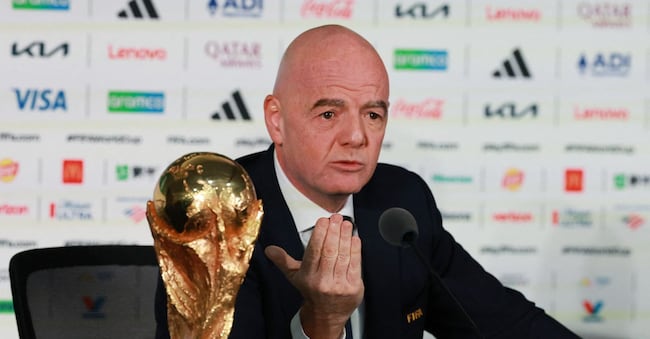
Il presidente della FIFA Gianni Infantino  (REUTERS/Henry Romero)

4' min read

Translated by AI
Versione italiana

4' min read

Translated by AI
Versione italiana

The quip, as is often the case when Gianni Infantino utters it, has a hidden meaning. “Let’s enjoy this 48-team World Cup,” said the FIFA president last Friday in an interview with a Brazilian TV channel. He added: “We have already considered the possibility of expanding the tournament to 64 teams to involve the whole world even more. The matter has been put before the FIFA Council. With 64 teams, perhaps Italia could qualify... and we could even go up to 208 to be sure of their participation.” Smiles, a few polite laughs, and a chill descended on the halls of Italian politics.

The FIGC’s response was not long in coming. There was no direct response, but rather a reference to the sporting values of the national team and the work currently underway to restore it to the ranks of international football’s elite. The Minister for Sport and Youth, Andrea Abodi, was more explicit, calling on Infantino to ‘respect the history and dignity of Italian football’.

Loading...

Behind the irony of the FIFA president, who has been governing world football from Zurich for a decade, however, a more complex web can be glimpsed, one woven from geopolitical balances, alliances and personal friction. To fully understand the meaning — and perhaps the target — of his outburst, one must look back to that rift with FIGC president Gabriele Gravina, which, despite appearances, has never been fully mended. A rift which, in turn, has its roots in the growing conflict between FIFA and UEFA due to political and regulatory issues concerning governance, fixtures and competitions, which came to a head with the “Super League” affair. The plan for a new competition involving Europe’s top clubs, which emerged in the spring of 2021, threatened to strip UEFA of its financial control over the continent’s premier tournament – as well as its primary source of revenue – and, according to various accounts, involved Infantino himself, at least among its instigators.

In that context, Gravina made a clear choice to side with Aleksander Ceferin’s UEFA, in opposition to FIFA’s ‘modernisation’ drive. It is a decision that has never been fully accepted in Zurich.

And this is where a behind-the-scenes story revealed in the pages of Il Sole 24 Ore on 8 February 2023.

The Saudi project

Around the time the Super League scandal broke, in the spring of 2021, officials from the Saudi Arabian Football Federation presented the FIGC with a bid dossier for a joint bid — by Riyadh, Egypt and Italia — to host the 2030 World Cup. An unofficial bid, yet backed by FIFA, firmly rooted in the Saudi strategy of economic transformation and soft power outlined in Vision 2030, which was pursued for several months, and for which an evocative promotional video was also produced, featuring a football kicked towards Mecca that traced a parabolic arc to Luxor and then, with a second touch, flew on to the Colosseum. In exchange for Italian football expertise, Riyadh would have covered a large part of the investment required to modernise Italian stadiums. An operation, therefore, with significant economic and diplomatic implications, which led to intensive dialogue between federations and institutions, culminating in contacts with the Italian government of the time led by Giuseppe Conte.

Gravina played for time. This was due both to the difficulties in implementing the plan – given the human rights issues and the diplomatic row with Egypt over the Regeni murder – and to the political consequences: endorsing a non-UEFA bid would have meant upsetting a very delicate balance, with tensions between UEFA and FIFA over the economic and political control of football having, if possible, intensified in the meantime amid proposals for a biennial World Cup for national teams and a World Cup for clubs (later to be played in 2025 in the US).

In the end, Italy chose not to go down that route and instead to strengthen its ties with UEFA, which subsequently came to pass with the appointment in April 2023 of Gravina as vice-president and the joint award of the 2032 European Championship to Italy and Turkey (a country with far more modern stadiums than Italy and which could have hosted the event without any problems).

Meanwhile, the Saudi bid – which has grown increasingly strong thanks to the Kingdom’s rise in global football, with the awarding of the 2027 Asian Cup, the purchase of Newcastle and the signing of stars of the calibre of Cristiano Ronaldo – was first revised, replacing Italia with Greece, and then postponed until 2034, when Saudi Arabia will indeed host the expanded World Cup featuring 48 national teams on its own.

It is in this context, therefore, that Infantino’s remark should be understood. It is not merely a provocation, but a message to a federation that has chosen a different path in a game where the boundaries between sport, politics and economics are becoming increasingly blurred. For Italia, the challenge is now twofold: to regain competitiveness on the pitch and to reclaim a central role at the tables where the future is decided – not just for football.

Copyright reserved ©

Brand connect

Loading...

Newsletter

Notizie e approfondimenti sugli avvenimenti politici, economici e finanziari.

Iscriviti

Tutto mercato WEB