
Children? No thanks. Mothers' fatigue discourages girls' motherhood
The postponement of the choice to become a mother is growing: costs discourage and incentives are not enough to change one's mind
by Flavia Landolfi and Manuela Perrone
 Aggiungi Il Sole 24 Ore
ai preferiti su Google
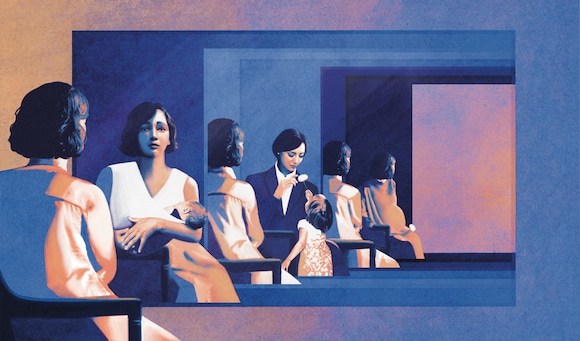
Daughters look at us. And what they see takes them away from motherhood. Tiredness, constant running, jobs held together by interlocking, acrobatics to reconcile everything: private life and work, social life and family. Children, indeed. And then also elderly parents. Mothers as social shock absorbers: a reality that one pretends not to see, but which is there for all to see. The result is a burnout that bends the mothers, but ends up infecting the daughters as well, who watch them run, exhausted, and ward off the spectre of ending up like hamsters in the same wheel.
The numbers could not be clearer. According to the report on 'Fertility Intentions' published by Istat in December, in 2024 just 21.2% of Italians between 18 and 49 years of age say they want to have a child in the three years following the interview. It was 25% in 2003. More than 10.5 million people do not want to have children or more children either in the short term or in the future. But the figure that weighs most heavily is another: more than 65% of younger women (18-24 years) think that the arrival of a child will worsen their job opportunities. And half of the women believe that with a baby their working conditions will get worse.
It is not a false perception, but a truth. According to the data provided by Istat to Save the Children for the report 'The Balancing Wives', in 2025 the employment rate of mothers between 25 and 54 years of age with at least one child of pre-school age will stop at 58.2%, while among women without children of pre-school age it will be 66.1%, about 8 points apart. The motherhood penalty is the child of die-hard prejudices. This is proved by its opposite: the fatherhood bonus, which rewards men who become fathers at work, perceived as more reliable. In fact, 59% do not imagine any effect of fatherhood on their working life. It is a stark, almost brutal distance: the choice of parenthood is immediately perceived as asymmetrical.
This is not surprising. The girls have seen and are seeing mothers in and out of work, slowing down, giving up, carrying double and triple loads. They have seen careers shrink, personal time disappear, energies depleted. They have seen motherhood turn into an endurance test, producing real inequalities. The experience becomes a stronger warning than any incentive. And the birth rate freeze persists: in Italia in 2025 just 355,000 children will be born, -3.9% compared to 2024. The overall population only holds thanks to migration. The average number of children per woman is still falling: 1.14 in 2025, against 1.18 in 2024. And the average age at childbirth rises to 32.7 years.
The bottleneck is also demographic. The decline in births is due both to the lower propensity to have children and to the reduction in the number of potential parents. Within this transformation, the family is also changing. Single-person households are now the most widespread form: 37.1% of the total. Couples with children, for years the prevalent model, have dropped to 28.4 per cent, those without children are 20.2 per cent.

