
Children's books take off, but the market fears the risk of inflation
At the Children's Book Fair in Bologna, Italian publishing regains positive numbers after 2025 decline. Vouchers for small publishers arrive. But in the background remains the unknown factor of household purchasing power

Key points
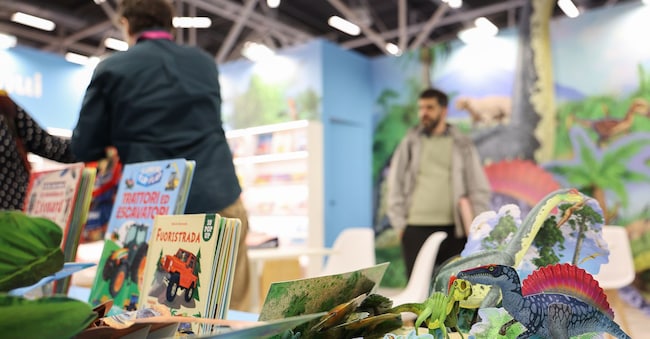
In Bologna, for a few days, the book seems to have regained its best posture: that of a living, international, even confident object. The corridors of the Bologna Children's Book Fair, with their 1,400 exhibitors from 90 countries and Norway as guest of honour, tell of a children's publishing industry that is running, and more than the rest: +8.3% in the first three months of 2026. The entire sector, after a negative 2025, is nevertheless back in positive territory, around +3 per cent.
The risk of inflation
This is good news. But it is also news to be handled with caution. Innocenzo Cipolletta, president of the Italian Publishers' Association (Aie), captures the double register of the moment: '2026 has started well for publishing, both for children's publishing' and 'for publishing in general'. Then he adds: 'I do not hide the fact that we also have some worries because with the deterioration in families' purchasing power due to the inflation that is taking place, it is likely that there will be less support later in the year, but we are optimistic, we hope that the year will end on a positive note'.
This is a real concern, which concerns the resilience of demand more than production capacity. Because books, especially non-school books, remain a discretionary choice, exposed to variations in disposable income. "This year,' Cipolletta adds, 'the Youth Card remains the same as in 2025, but next year it will be a different card and certainly a positive one because it will be given to everyone who graduates. It will be more extensive than the two current ones, which so far have not rendered what they should have rendered. Then we hope that there will be a contribution and tax exemption for school books. This is also important because if families have to spend on school books, they then obviously spend less on others'.
Italian Leadership
"Children's publishing represents the segment in which Italia expresses a qualitative leadership recognised worldwide, an authentic instrument of soft power capable of forming new generations of readers and with them the citizens of tomorrow," is the comment of the President of the Culture Commission of the Chamber of Deputies, Federico Mollicone. The data certainly tell of a robust specialisation: over 22 million copies sold, more than 3,400 rights sold abroad each year, a centrality that Italia still manages to bring to bear outside its borders. Lorenzo Galanti, Director General of Ice Agenzia, recalls that '40% of the rights sold abroad are in the field of children's literature, for young people.
Minister Giuli: 'Encouraging signals'
The Ministry of Culture claims good results. Alessandro Giuli speaks of 'very encouraging signs'. The library procurement fund, initially set at 30 million, has been doubled to 60 million for the two-year period 2025-2026. Of this, 54.8 million has already been allocated for 2025, with 4,522 libraries admitted out of 4,541 applications. In the first three months of the year, according to the Mic, sales in the main commercial channels rose by 3.4% in value and 2.5% in copies, while independent bookshops did even better: up 8.7% in value and 7.1% in copies.


