
Beijing criticises war, but opens dialogue with the US: 'Decisive year'
The Chinese foreign minister called for a ceasefire in Iran and said that "failure to confrontation would only lead to misunderstandings"
from our correspondent Marco Masciaga
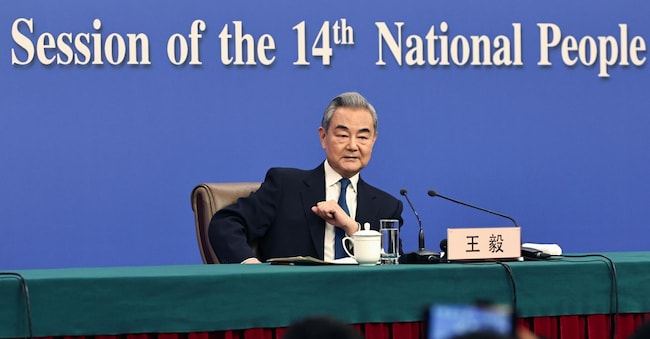
NEW DELHI - At an eagerly awaited press conference on Sunday morning, China's Foreign Minister Wang Yi stressed the need for dialogue with the United States and, while not confirming the US President Donald Trump's state visit to Beijing at the end of the month, said he hoped 2026 would be a "decisive year" in relations between the two countries.
During the meeting with journalists, Wang criticised the US and Israeli decision to attack Iran ("this is a war that should not have happened and that is not benefiting anyone") and called for an immediate ceasefire. But, at the same time, he emphasised the need for dialogue with the US, suggesting that - despite the regime change operations carried out by the Americans against two of China's strategic partners such as Iran and Venezuela - Beijing's priority remains the stabilisation of relations with Washington.
Loading...
The risk of escalation
"The lack of dialogue between the two nations," Wang said, "would only lead to misunderstandings and misjudgments, with the risk of escalation to confrontation and damage to the world. Speaking about the possible meeting at the turn of March/April between Chinese President Xi Jinping and Trump, Wang said that "the agenda for a high-level confrontation is on the table. What is necessary is for both sides to make thorough preparations to create an environment conducive to managing existing differences'.
In preparation for the meeting, US Treasury Secretary Scott Bessent, US Trade Representative Jamieson Greer and Chinese Vice-Premier He Lifeng are expected to meet next weekend in Paris to lay the groundwork for a new agreement that should also include business-to-business trade understandings. Last October, China and the US reached a temporary compromise on the US tariffs issue after Beijing responded to US tariffs by introducing limits on minerals critical exports.
The impact of regime change on China
A hard-fisted balance, the one between the two superpowers, which in recent weeks has come under further strain after the decapitation of regimes in Venezuela and Iran, two countries central to Beijing's energy supply strategies. "A hard fist does not equal a strong reason," Wang said in a clear reference to the increasingly muscular US foreign policy. "The world cannot return to the law of the jungle. Resorting to force at every opportunity does not demonstrate one's power'.


Brand connect
Loading...
