
China and South Korea closer (at the expense of the US and Japan)
Chinese President Xi Jinping and his South Korean counterpart Lee Jae Myung met for the second time in just over two months

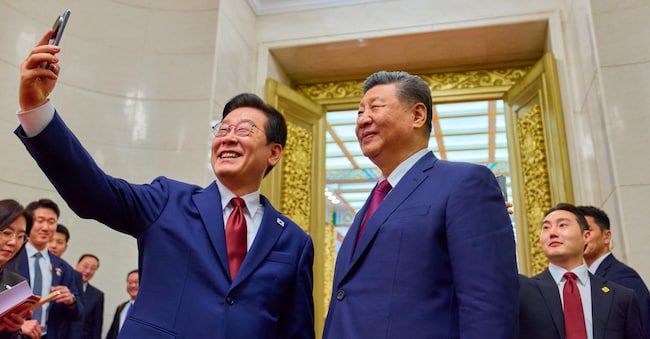
From our correspondent
NEW DELHI - In an increasingly unstable world, in which the very norms of coexistence between allies are being questioned, the leaders of China and South Korea announced yesterday that they would inaugurate "a new phase" in their not always easy, bilateral relations. All this, one can infer from the tenor of the statements, at the expense of Japan, the US and Taiwan.
The occasion was provided by the four-day visit to Beijing and Shanghai initiated by South Korean President Lee Jae Myung on Sunday. It is the first official mission to China at this level since 2019 as well as the second summit between Lee and his Xi Jinping counterpart in the space of just over two months, after the Chinese president made his first trip to South Korea in 11 years last October.
A new beginning
"This summit," Lee said yesterday, "will be an important opportunity to make 2026 the first year of a full restoration of relations between Korea and China. I believe efforts to make strategic cooperation and partnership between the two countries an irreversible trend these days will continue'. A reference, to the political conjuncture, that seems to be a reference to the trade wars unleashed by the Trump administration. Xi, referring to an 'increasingly chaotic and complex international situation', said that China and South Korea should make 'correct strategic choices'.
The nodes of the economy...
What these choices should be was quite clear. On the economic side, the high road is that of greater integration between the two economies. Following the South Korean president are the top executives of more than 200 companies, including Hyundai and two semiconductor giants such as Samsung and Sk Group, and Monday saw the signing of 15 agreements to increase cooperation in areas such as technology, intellectual property and transport. Chinese companies that have signed contracts include Lenovo and Alibaba. Lee also mentioned artificial intelligence and the cultural industry as areas for increased exchanges, although according to his own chief of staff, it is hard to imagine an end to the unofficial but de facto ban on South Korean music and film products in China any time soon.


