
China and the Nordic countries are riding the wave of electric vehicle fleets
Beijing has launched the world’s largest battery-powered merchant ship. Only zero-emission vessels are permitted in the Norwegian fjords

Key points
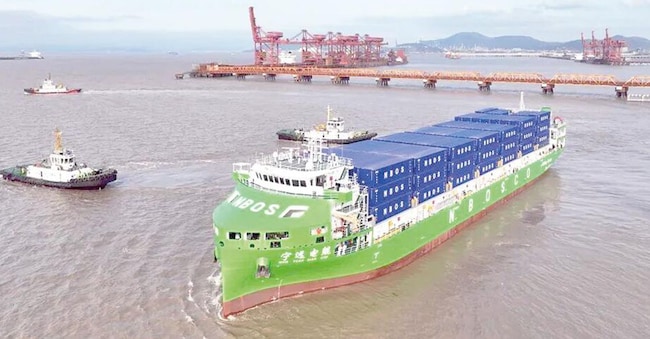
A new 10,000-tonne container ship has been sailing the seas off China since last month. It is called the Ningyuan Diankun and, whilst it might be mistaken for any other merchant ship, it possesses several truly exceptional features: it is electric and completely autonomous. It is not the first and will certainly not be the last, but for now it is the world’s largest electric container ship. Launched in the port of Ningbo – the world’s largest in terms of cargo tonnage handled, situated on the Yangtze River delta – the ship’s name references the Kun, a Leviathan from Chinese mythology capable of transforming into a bird, and electricity, ‘Dian’, thus blending the ancient with the modern.
Measuring 128 metres in length and 22 metres in width, the Ningyuan Diankun has a capacity of 740 TEUs (Twenty-foot Equivalent Unit, corresponding to a standard 20-foot container) and was designed by Sdari, whilst the 20 MWh electric propulsion system was supplied by the Shanghai Marine Equipment Research Institute. Both organisations are part of China State Shipbuilding Corp, the world’s largest state-controlled shipbuilding conglomerate. For its electric propulsion, the vessel is fitted with ten power modules, each the size of a standard container, providing a capacity of almost 20 MWh and a range of 100–180 nautical miles depending on speed and load.
Zero emissions and zero noise
“This enables the vessel to operate in fully electric mode, with zero emissions and zero noise for the entire duration of the journey, perfectly suited to the operational requirements of coastal transport,” explained Ma Hongmeng, the project manager, to *China Daily*. According to Ma, we are at the dawn of a new era for China’s coastal container shipping. And Ningyuan Diankun’s parent company confirms this: “Ningbo Ocean Shipping owns 32 eco-friendly, energy-efficient vessels, accounting for 57 per cent of its fleet, and 19 smart vessels, representing 34 per cent of the total: a sign of the progress made in modernising towards low-emission and smart-driving solutions.”
Only electric boats in Amsterdam
According to industry players, the electrification of maritime transport is the next major market to emerge, but this industrial revolution is taking place almost exclusively in China – just as is the case with electric cars. The Scandinavian countries are following a similar path, having been working on the electrification of their fleets for some time now, particularly Norway, the first European country to launch an autonomous electric container ship, the Yara Birkeland, with a capacity of 120 TEUs, to transport goods along coastal routes. Furthermore, as of this year, only zero-emission vessels are permitted to enter the Norwegian fjords, meaning that all tourist fleets have had to switch to electric power. The same applies to Amsterdam, where only electric-powered boats are now permitted to enter.
CATL: batteries for the oceans within three years
China, however, is well ahead. The maritime sector’s transition away from fossil fuels is crucial to Beijing’s broader objectives regarding decarbonisation and energy independence. Batteries, which are particularly well-suited to coastal shipping operations, are the primary alternative to heavy fuel oil, whilst for deep-sea shipping, other solutions are being explored, ranging from ammonia to hydrogen. The large-scale adoption of electric ocean-going vessels has not yet materialised due to the low energy density of current batteries compared to fossil fuels, but the world’s largest battery manufacturer, CATL, is convinced that “we will get there within three years”, as Su Yi, head of CATL’s marine applications division, stated at the latest Marintec China trade fair.

