Search

China beats US on hypergravity centrifuge

Technology simulates catastrophes and new materials. But it can also serve military engineering
by Leopoldo Benacchio

3' min read

Translated by AI
Versione italiana

3' min read

Translated by AI
Versione italiana

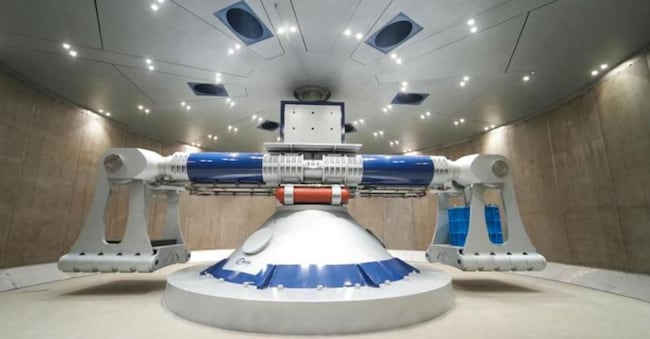
In a world where, for months now, there has been nothing but talk of ever denser and more powerful artificial intelligence, it seems perhaps strange to be dealing with a centrifuge machine that is at least seven metres in size and weighs hundreds of tonnes. It was built and put into operation by China, which has now understood very well how technological supremacy also passes through basic physics, that made up of large machines, which produce events with exceptional forces and accelerations compared to our everyday life.

What is gravitational attraction?

Thus was born the second Chinese colossal centrifuge, Chief1900, built by the Shanghai Electric Nuclear Power Group and delivered to Zhejiang University shortly before our Christmas 2025.

Loading...

We have experience of centrifugal acceleration since we were children, riding on some merry-go-round going round in circles, not to mention the washing machine, which is so fast at spinning that it sometimes even moves the washing machine itself. Here, we are in different fields: the best washing machine centrifuges at 2g, while here we are talking about 300g, where g indicates the gravitational attraction, the one that makes a glass that slips out of our hand fall to the ground. It is an unexplored field in which we can compress space and time, in the sense that we can recreate catastrophes, like earthquakes of course in a controlled way, but also study how to produce new materials at that level of compression. It is the world of hypergravity, which is very promising.

Overtaking the Americans

The record was up to 2025 by the US Army Engineers, with a machine in Mississippi capable of turning a tonne of material to 1200 g-tonne, an already frightening number.

China had already overtaken the Americans last year, in September with the Chief1300 which is now joined by the more powerful Chief1900 and the US becomes third after the first two Chinese.

But what is the point of such a machine, apart from the allure of the record, which is attractive in any case. It is easy to say: with this machine we can simulate, in a few hours, what would happen to a material or artefact over hundreds of years of wear. But it is also used in reverse, to understand what can happen to such high stresses in a thousandth of a second.

All possible simulations

The examples given by the Chinese scientists at the presentation of the new super centrifuge are many: for example, by building a 1:100 scale model of a dam, let's say 3 metres against the 300 of the future real dam, and spinning it at 100g, we will have in a few hours the test of how the real dam will react when completed.

Another notable example, and one that would not immediately come to mind, is how a pollutant works on the earth's soil: the centrifuge can easily accelerate the process of fluid infiltration into the ground over the next hundred or thousand years, so that we can see in a few hours what will happen.

Military uses

It is obvious that these structures are also useful for military engineering, as in the US, since they will be able to simulate extreme pressures in the case of submarines or drones or test aerospace materials for missiles or capsules that must re-enter the atmosphere. For a dual application, useful for civil and military, it could also be used to create alloys that can only form under enormous simulated gravitational pressures.

Chief 1300 and 1900, whose data sheet is not available, were built within a national programme for the construction of strategic infrastructures, with around 260 million euro, by constructing the large laboratory that contains them both 15 metres underground, to minimise vibrations and ensure stability, as tonnes of material are rotated at hypersonic speeds.

What challenges and what risks?

The laboratory itself is a piece of high engineering, for example for heat containment and dissipation. At the impressive rotational speeds that are imposed on the long arms of the machinery, friction with the air generates so much heat that it can melt the entire system. The construction pushed the Chinese engineers into uncharted territory; the thermal challenges were immense. Air friction at those speeds would generate enough heat to melt the system. So a temperature control system was developed that circulates coolant, typically water with ethylene or propylene glycol, essentially antifreeze, through a system of pumps in the arms. The Chief1900 is yet more proof that the centre of gravity of science is shifting eastwards, because it is there that the state takes the economic risks of major initiatives, which it then makes everyone use: universities, research bodies, laboratories.

Copyright reserved ©
Loading...

Brand connect

Loading...

Newsletter

Notizie e approfondimenti sugli avvenimenti politici, economici e finanziari.

Iscriviti