
China bets on the Arctic: first cargo ship departs, only 18 days (instead of 50) to arrive in northern Europe
Today, 20 September, the Istanbul Bridge, a container ship of almost 4900 Teu, departs. The route is northern but cutting off Russian ports

6' min read
Key points
6' min read
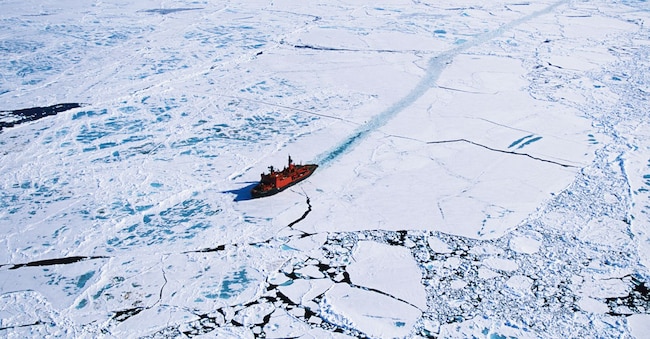
No longer just isolated shipments or test voyages, from this month the Arctic becomes the scene of an experiment that could change the maps of world logistics. For the first time, in fact, a Chinese shipowner will inaugurate a regular container link between the ports of the Far East and those of Northern Europe, taking advantage - thanks to global warming - of the increasingly less icy waters of the polar route.
The link bears the already evocative name China-Europe Arctic Express and will be operated by the company Haijie Shipping, also known as Sea Legend. It is not a historical shipping giant, but an operator that emerged in recent years, during the Red Sea crisis, when Chinese ships began travelling under military escort. Now the company raises the bar and brings the Northern Sea Route to a level of normality for the first time: a scheduled line, with fixed timetables and ports of call.
A small but symbolic ship
.The star of the maiden voyage will be the Istanbul Bridge, a 4,890 TEU container ship, reinforced to resist ice. A unit of limited size when compared to the giants crossing Suez or Panama, capable of transporting over 20,000 TEU, but significant for a corridor where occasional voyages have dominated until now. Departure is scheduled for 20 September from the port of Ningbo-Zhoushan and will end almost three weeks later when the ship will dock at the UK's largest container port, Felixstowe. During the voyage it will call at Rotterdam in the Netherlands, Hamburg in Germany and Gdansk in Poland as well as two other Chinese ports of departure, Qingdao and Shanghai.
The striking fact is the journey time: 18 days from Ningbo to Felixstowe, less than half the time compared to the traditional passage via the Mediterranean and Suez Canal in which ships take 40 to 50 days to reach Northern Europe. It is precisely this reduction in time that is pushing Beijing to accelerate on the Arctic front, despite the risks and unknowns.
A seasonal service, for now
.For the time being, the link will only be operational in the summer months and early autumn, when the ice retreats. The seasonal window therefore remains limited, but the stated aim is to gradually expand the operational capacity with vessels designed to cope with harsher conditions. Looking ahead, Beijing aims to turn the Arctic into a year-round navigable corridor. 'Actually, the Arctic route has existed for some time,' stresses Leonardo Parigi, coordinator of the Arctic Observatory. 'There are already three usable northern passages. What is new today is not technical but political: the challenge is played out on the will of the states'.
The Three Ways to Europe
.Experts distinguish three routes. There is the Northwest Passage, which skirts Canada and Alaska to connect the Bering Sea to the Atlantic: a complex route, hostage to territorial disputes and persistent ice. There is the Northeast Passage, better known as the Northern Sea Route, which follows the Russian coastline and has seen an increase in transits in recent years due to the seasonal retreat of ice. Finally, scientists are looking at a third hypothesis: the Polar Route, which between 2050 and 2060 could open a direct corridor from China to Greenland by crossing the heart of the Arctic Ocean. It is precisely the Northern Sea Route that is the most attractive route today. It is this route, scientific literature explains, that makes the distance between Asia and Europe up to three times shorter than Suez. An advantage that for shipping companies translates into faster times and lower costs.
The cost-benefit
.The operation is not smooth sailing, however, and in addition to the climatic constraints there are the cost-benefit assessments. 'It is true,' Paris continues, 'that the journey times are more than halved, but you have to consider the insurance policies, which in the North Sea are much heavier because of the environmental consequences of even a small fuel leak, to give one example. An emphasis that also looks at the Russian economy. 'The Kremlin has invested a lot in ports,' Paris continues, 'Suffice it to say that 14% of Russian GDP comes from hydrocarbon extraction in the Arctic. An area where interests intersect. And they are all hot. But the Northern Route has to reckon with reality: and therefore not only with the seasonality of a route that at best is open from May to mid-October, but also with the Polar Code, the bible of international rules adopted by the Imo (International Maritime Organisation) and entered into force in 2017. The Code mandates safety and environmental standards for ships sailing in polar waters (Arctic and Antarctic). Such as technical safety requirements, crew training and precisely the environmental rules for anti-spillage, waste and wastewater management. All chapters that cost money. 'For now,' Paris concludes, 'the costs-benefits could be even, what is gained in terms of time, is lost in the costs of complying with environmental rules'. The game, then, could be all politics. Let's see it.


