
China lowers growth target to lowest since 1990: +4.5-5%
In addition to geopolitical uncertainty, there are internal structural problems. Meanwhile, according to anticipations, in the Five-Year Plan to be voted by Parliament in plenary, a prominent place will be occupied by artificial intelligence
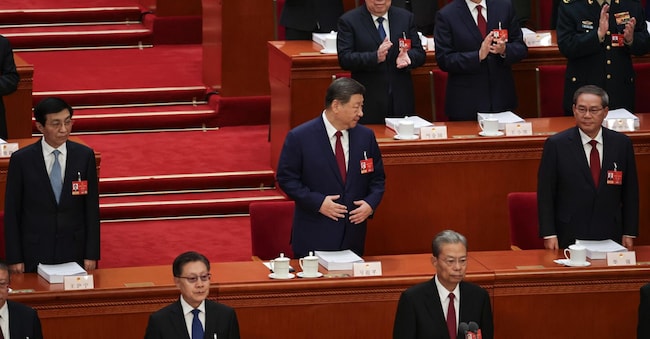
It was Premier Li Qiang's turn at the opening of the Two Sessions of the Chinese Parliament to announce to the 3,000 delegates the prospect of the most modest GDP growth since 1990, a range of between 4.5 and 5 per cent, which falls well short of the last three years' painful pace of about 5 per cent.
The country's GDP is still expected to reach a record $20.4 trillion, but flexibility in numbers is the new mantra. And, one can see why.
Loading...
The year 2026 is fraught with uncertainties, with unresolved trade disputes and the recent double US military blitz on Venezuela and Iran putting 14% of China's oil imports and the mountain of billions of dollars in loans granted to these countries to date at risk. Li Qiang, not surprisingly, notes in his Work Report the multitude of complex problems that are weighing on China's economy, a mix of a "drastically changed international economic and trade environment" and "deep-rooted structural problems" crucial to driving consumption and investment.
Thus, Beijing is forced to focus on quality growth, net of the unforeseen, always lurking, increasingly difficult to manage on a slippery international chessboard. While the marches of the military band resound in the Great Hall of People packed with representatives of the two branches of parliament, bombs are exploding in the Middle East (and beyond). But China goes ahead with its domestic priorities: inflation at 2%, the lowest level for more than two decades, an indicator of weak domestic demand, as well as declining consumer confidence, so much so that price growth last year was 0.7%, a clear risk of deflation; the budget deficit at around 4%, identical to last year; the urban unemployment rate, which last year stood at 5.2%, will be around 5.5% in 2026; and the goal of creating 12 million new jobs in urban areas.
If domestic consumer demand remains stagnant, foreign investment is to be relaunched by leveraging the liberalisation of procedures with the new catalogue of favoured investments as of 1 February and the doors open to nations not perfectly aligned with Donald Trump, Mark Carney's Canada, Keir Starmer's Great Britain, Sanchez's Spain. And, above all, the crucial role of the longa manus of Hong Kong, the Special Administrative Region on whose reinforcement Beijing relies heavily.


Brand connect
Loading...
