
China: at the top of defence the general who investigated the nine expelled colleagues
The Fourth Plenum which closed yesterday with a record absenteeism ('only' 82% of the 300 eligible participants attended)
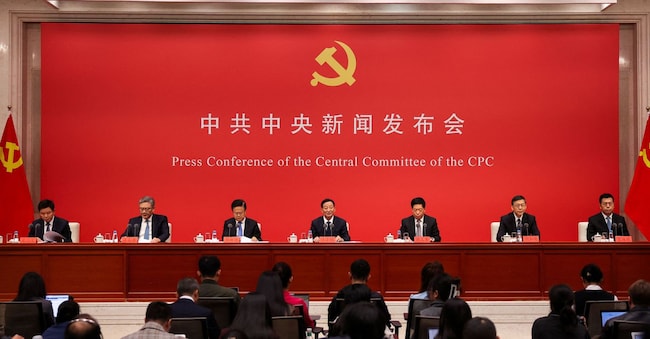
The Fourth Plenum, which closed its doors yesterday with a record absenteeism ('only' 82% of the 300 eligible participants attended), projected the very general who led the investigation into nine colleagues accused of serious violations to the top of the Chinese defence.
Thus, He Weidong, Miao Hua, He Hongjun, Wang Xiubin, Lin Xiangyang, Qin Shutong, Yuan Huazhi, Wang Chunning and Zhang Fengzhong were expelled from the Party, while military anti-corruption chief Zhang Shengmin was appointed deputy of the Central Military Commission chaired by Xi Jinping himself.
Having healed the wound in the Armed Forces, the Plenum moved on to heal the offences inflicted on party discipline by a handful of officials of the rank of Tang Renjian, Jin Xiangjun, Li Shisong, Yang Fasen and Zhu Zhisong.
The official communiqué
A double flurry of exemplary purges, paving the way for the modernisation of the military system and its ability to guarantee national security, in order to achieve the objectives of the centenary of the People's Liberation Army and the reaffirmation of the party's centrality. Because "only a party that thrives can make our country strong", the official communiqué of the Plenum states in clear letters.
The assembly then deliberated and adopted the Party Central Committee's Recommendations for the formulation of the 15th Five-Year Plan for Economic and Social Development. China is on the verge of realising the main goals and tasks of the 14th Five-Year Plan (2021-2025), which marked an important and extraordinary period in the country's development. The 15th Five-Year Plan (2026-2030) will be crucial as the country "works to strengthen the foundation and move forward on all fronts towards achieving socialist modernisation by 2035".


