
Systemic power China: global interlocutor, no longer just antagonist
The Western world, Europe in particular, finds itself in many ways trailing behind, slowed down by certain structural and cultural factors

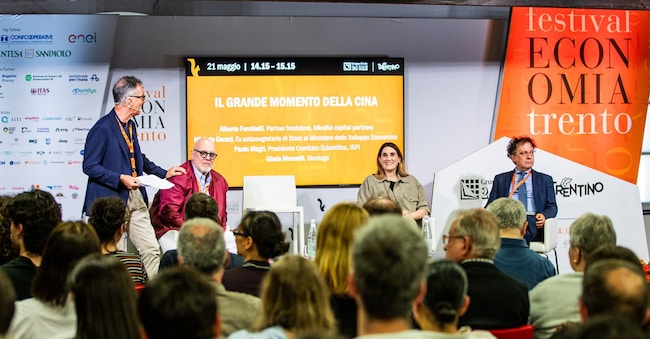
China is now a systemic power and its weight in the current scenario cannot be ignored. There is no shortage of examples: if Beijing accelerates on the electric car, it changes European industry, if it restricts exports of rare earths, it transforms world economic security, its intervention can change the direction of a conflict. And while the country carefully plans the path for its future, it remains to be seen whether, for the Western world, it represents more of an opportunity or a risk factor.
"It is difficult to say that China represents an opportunity. It is penalising us strongly, but much of it is our fault. On the face of it, it has few weak points, for example consumption that does not take off, but which is compensated for by an explosion in exports that is growing by more than 20% per year,' said Alberto Forchielli, founding partner of Mindful Capital Partners, speaking during the panel 'China's big moment' as part of the Trento Festival of Economics.
On the one hand, it is true that China has to manage some critical issues and face slower growth, the consequences of the securities crisis, a demography that has become unfavourable, American pressure, and above all a more complex relationship between growth, political control and global ambitions. On the other hand, however, it is also true that the country is smoothing the corners, positioning itself as an interlocutor, no longer just an antagonist, on crucial issues, trade, technology and energy in the lead.
And he appears able to learn quickly from his mistakes: 'I was one of the first to bring Chinese companies to invest in Italia in 2008 and I remember all the difficulties, the mistakes, the trivialities they made. I told myself that they would never be able to match companies like Ibm, Intel, General Electric. Instead, today there are flourishing companies, there is Byd that leads the world in electric vehicles, there is Catl that leads the world in batteries, Huawei's expenditure on research is bigger than Intel's turnover,' Forchielli stressed.
The western world, Europe in particular, finds itself in many ways catching up, slowed down by certain structural and cultural factors. "The problem," he stressed, "is that we are dealing with a power that what it says, it does. In the West we make plans, then the party in government changes and the plan changes. We never manage to implement the plans'. In a way, he added with a provocation, "we should 'contain' democracy, try to change the mechanisms that regulate it, which we never manage to do".


