Political influences

China’s cultural soft power is winning over Italia

A network of initiatives suggests a reciprocal exchange through the gradual development of Sino-Italian cultural spaces, in which the public and private sectors, institutions, museums, foundations and galleries all contribute to forging new relationships

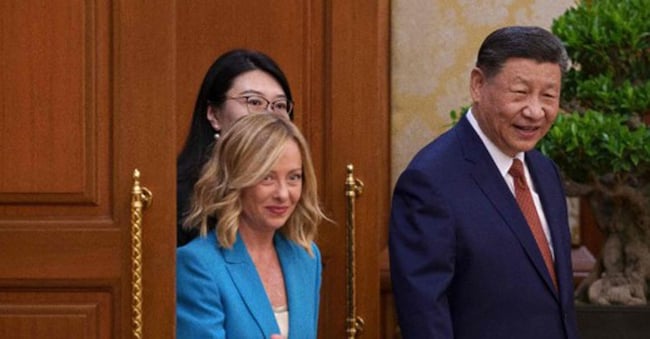
Giorgia Meloni con Xi Jinping

7' min read

Translated by AI
Versione italiana

In recent decades, the West has been swept by increasingly significant waves of Asian cultural influence. Following the global expansion of Japanese culture, driven by various media, the momentum of Chinese culture is proceeding, one might say, ‘at a gallop’.

A strong cultural diplomacy is, in fact, in line with the objective of Chinese foreign policy to create a multipolar global order capable of reducing Western influence. To counter Western hegemony (understood as that of the US, Europe, but also West Asia), the People’s Republic has learnt that states do not live and thrive on hard power alone. It is no coincidence, therefore, that Chinese soft power is now increasingly evident in Europe and in Italia. This is also evidenced by the numerous exhibitions, funded by Chinese public and private bodies, which in recent years have brought Chinese artists to our country, often through collaborations between Italian cultural institutions and organisations from the People’s Republic.

Loading...

China’s cultural soft power

The concept of soft power, developed from the 1990s onwards by the political scientist and Harvard professor Joseph S. Nye, refers to a country’s ability to exert influence through attraction, rather than through coercive or economic means. According to Nye, a state’s soft power depends primarily on three resources: culture – when it is seen as attractive by other countries; political values – when they are shared and recognised even beyond national borders; and foreign policy – when it is perceived as legitimate and authoritative, including on a moral level.

The People’s Republic is now seeking to utilise all three of these levers as far as possible. In particular, the gradual scaling back of the United States’ role in certain international bodies and programmes has opened up new avenues of influence. The Trump administration’s foreign policy, which is geared towards withdrawing from certain multilateral organisations, such as UNESCO, and characterised by a growing mistrust of parts of the international legal framework, has helped to create a favourable environment for the expansion of China’s presence.
Washington’s withdrawal strengthens Beijing’s position, as it has long been seeking to expand its international influence. Consider, for example, that China is second only to Italia in terms of the number of sites inscribed on UNESCO’s World Heritage List: in 2025, China had 60 sites, compared with Italia’s 61.

Furthermore, one of the distinctive features of soft power is that, unlike hard power, it is not exercised almost exclusively by states. Non-governmental actors also contribute to shaping a country’s international image and appeal: film producers, writers, artists, musicians, comic-book artists and cultural practitioners. And it is precisely the arts sector – which partly fuels so-called cultural diplomacy – that is one of the areas in which China’s growing presence in Italia is most evident today.

Rome: the National Gallery of Modern and Contemporary Art

Rome offers a unique vantage point. At the National Gallery of Modern and Contemporary Art (GNAMC), the ‘National Exhibition of Chinese Contemporary Art”, curated by Gabriele Simongini (art historian and scholar of Italian abstract art) and Franco Wang. This quinquennial event is supported by the Chinese Ministry of Culture, the Federation of Literary and Art Circles of China, the China Artists Association and the Embassy of the People’s Republic of China in Italia. The 2025 exhibition was organised by the China-Europe Foundation for the Arts.

Also at the Gnamc, from 7 March to 8 April 2026, the exhibition “Gulistan. Time Garden”, once again curated by Simongini. The exhibition was dedicated to the painterly work of Gulistan, an artist on the contemporary Chinese scene, and was supported and organised by the Foundation for Chinese Art in Italia and co-organised by the International Federation of Women Artists 923 Art Space.

The dialogue between Italia and China had also been the focus, in 2025, of ‘East and West. International Dialogue Exhibition. From Shanghai to Rome’, curated by Simongini and Zhang Xiaoling and organised by the Ministry of Culture, the National Gallery of Modern and Contemporary Art, the Shanghai Academy of Fine Arts and the Shanghai Artists Association, and produced by Zhong Art International, under the patronage of, among others, the Embassy of the People’s Republic of China in Italia. With over 40 artists involved, the project centred on a dialogue between artists from Shanghai’s contemporary scene and the National Gallery’s historical collection, with which the Chinese artists engaged. The following artists were invited to represent the People’s Republic: Zeng Chenggang, Chen Jialing (50,000–100,000 HKD at Christie’s), Xia Yang (Lin & Lin Gallery, Taipei), Hsia Yan (Lin & Lin Gallery, Taipei), Ding She (Lisson Gallery), Li Lei (3812 Gallery and Leo Gallery), Xu Jiang (Tang Contemporary Art and Tina Keng Gallery), Zhang Jianjun (Pearl Lam Galleries), Yu Youhan (ShanghART Gallery and Alisan Fine Art), Li Xiangyang, Gu Gan (Alisan Fine Arts and Gajah Gallery).

Venice: Wallace Chan and Ding Yi

The Chinese presence on the Italian exhibition scene also extends to Venice. Wallace Chan, a Chinese artist and goldsmith based in Hong Kong, returned to Venice in 2026 following a series of participations in conjunction with previous Art and Architecture Biennales (‘Titans’ in 2021, ‘Totem’ in 2022 and ‘Transcendence’ in 2024). To mark the 61st Venice Biennale, Chan is the focus of two exhibitions. The first, ‘Mythos’, hosted at the Scala Contarini del Bovolo from 4 April to 18 October 2026, presents a series of large titanium sculptures inspired by classical mythology and the painting ‘Mercury’ and the ‘Three Graces’ by Tintoretto, placing the artist’s work in dialogue with Venice’s historical and artistic heritage. The second, ‘Vessels of Other Worlds’, is on display in the Church of Santa Maria della Pietà and remains open to visitors until 18 October 2026. Curated by James Putnam, the Venetian exhibition runs in parallel with the exhibition of the same name organised at the Long Museum in Shanghai, creating a direct link between the two cities and their respective audiences.

Also in Venice, a solo exhibition is currently being held by one of the leading figures of Chinese abstract art: Ding Yi (Lisson Gallery), who is based in Shanghai and is exhibiting at the Fondazione Querini Stampalia. The curators Alfredo Cramerotti and Auronda Scalera have brought together old and new works by the artist, alongside a series of stone steles that form the centrepiece of the exhibition as a space for reflection and ritual, evoking ancient sites in China and Europe.

Loading...

From L’Aquila to Milan via Florence: Ai Weiwei and Chinese artists

The growing visibility of Chinese artists in Italian institutions is not limited to the examples outlined so far. The renowned artist Ai Weiwei was featured in the exhibition ‘Metafisica/Metafisiche 1909–1926’ at Palazzo Reale in Milan, which closed on 21 June 2026. Meanwhile, at MAXXI L’Aquila, ‘Aftershock’ is currently on display – a major retrospective dedicated to Ai Weiwei, which can be visited until 6 September 2026. The artist’s works bring China and Italia closer together in the grief caused by the earthquake tragedy. Central to the exhibition is ‘Straight’, an imposing installation constructed from steel bars salvaged from schools that collapsed in the 2008 Sichuan earthquake. The exhibition then continues with images that are relentlessly striking: rubble, broken porcelain, videos, photographs, symbols of war, migration crises and denied freedoms.

In Milan, to mark the Milan-Cortina Winter Olympics, the exhibition ‘The Meaning of Snow. Peoples, Ancient Art and Contemporary Perspectives’, held at MUDEC – the Museum of Cultures in Milan, the work of Zhang Huan (Pace Gallery) was included alongside that of 30 artists of various nationalities, all exploring the theme of snow. The artist, based between Shanghai and New York, is one of the leading figures on the Chinese conceptual art scene.

To coincide with the exhibition at MUDEC in Milan, the results of China Project 2025 – the residency programme directed by Valentina Gensini and Xiuzhong Zhang – were presented in Florence, as part of the long-standing collaboration between MAD Murate Art District and Zhong Art International, made possible thanks to the support of Fondazione CR Firenze, which for years has been promoting cultural dialogue between Italia and China through contemporary art and research into environmental and social issues. The artists in residence were Liu Yuxuan (PIFO Gallery) and Wang Yi (Whitestone Gallery), whose works weave together memory, the body, history and the contemporary imagination.

From China to Italia and back again?

Rome, Venice, Milan, L’Aquila and Florence thus become points on an expanding cultural map. This growing presence, whilst being the result of the vitality and international success of individual artists, appears to form part of a broader strategy for the bottom-up expansion of China’s cultural soft power. If this is true, however, the reverse is also true. The Italian presence in China appears, in fact, to be just as intense and, particularly over the last year, has taken on a particularly multifaceted dimension.
To give a few examples, in 2026, Carloalberto Lucioni’s solo exhibition, ‘Ricerca del Centro’ (March, ICCF Academy Art Centre located in Raffles City, Dong Zhi Men, Beijing), were followed by ‘Ultimate Oneness – Type Art Exhibition’ by Lorenzo Marini (April–June, Yindi Art Museum, Beijing), ‘The Form of the Sign’ by Jacopo Della Ragione (April–August, Z Space, Beijing) and the first solo exhibition in China by Flatform, ‘Concert for Films and Works’ (May–June, Power Station of Art, Shanghai). These were complemented by the group exhibition ‘Le Divisament dou Monde: Italian Drawings on the Far East’, featuring 44 Italian artists and including, amongst others, Domenico Antonio Mancini (May–September, Jiangxi Provincial Art Museum, Nanchang), ‘Eterno Antico’ by Alessandro Giannì (June–July, Aurora Art Museum, Shanghai) and ‘Giorgio Morandi. Solo’ (June–October, Museum of Art Pudong, Shanghai), the largest exhibition ever held abroad dedicated to the Bolognese painter. Also taking place during the same period are ‘The Poetics of Survival’ by Lina Bo Bardi (June–August, Power Station of Art, Shanghai) and ‘Glasstress: Flowing Venetian Carnival’ (July–October, Shanghai Jiushi Art Museum, Shanghai), linked to the Berengo Foundation and the Murano glass-making tradition.

This network of initiatives therefore suggests that the phenomenon should be interpreted as a reciprocal exchange, as the gradual development of an increasingly rich Sino-Italian cultural space, in which the public and private sectors, institutions, museums, foundations and galleries, each playing different roles, contribute to the establishment of new cultural ties between the two countries.

Copyright reserved ©
Loading...

Brand connect

Loading...

Newsletter

Notizie e approfondimenti sugli avvenimenti politici, economici e finanziari.

Iscriviti