
Electric lorries: China is racing ahead whilst Europe is lagging behind
Acea is calling for progress to be made on the ecosystem. One of the problems is the lack of charging points

Key points
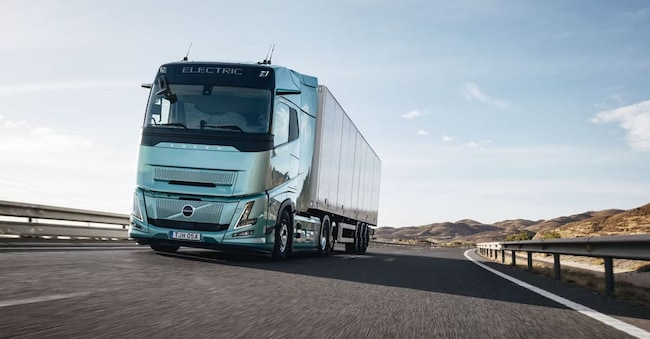
Volvo has launched its new battery-electric long-haul lorry this year, which boasts a range of 600 km on a single charge and can be recharged in 40 minutes. Renault’s latest model also has the same range, whilst the Chinese manufacturer Sany achieves 800 km. These are extraordinary advances, exceeding expectations. Just a few years ago, lorries were considered too difficult to electrify, given the amount of energy required in a single day. Instead, such improvements have been made in battery density that hydrogen-powered lorries have now lost their relevance. However, the purchase price (not the total long-term cost) of an electric lorry is at least double that of a diesel lorry. Despite this, according to a survey by the German think tank Öko-Institut, around a third of German logistics companies plan to use battery-powered electric lorries by 2030, and 77 per cent believe that by 2030 they will be the industry standard.
The risks for European manufacturers
According to figures from the International Energy Agency, by 2025 the electric lorry market had exceeded 420,000 units (9 per cent of the total market), compared with 93,000 units in 2023 and 16,000 in 2020. This represents exponential growth. The problem is that as many as 405,000 of these 426,000 vehicles were registered in China. Europe trails far behind, with just 16,800 electric lorries sold. This is a gap that currently seems unbridgeable and which risks sending European lorry manufacturers down the same path as car manufacturers. According to ACEA data, in fact, in the first half of this year, electric lorries accounted for just 3.6 per cent of new registrations in the EU, compared with 93.6% for diesel lorries, whilst in China the penetration rate for electric lorries has risen to 24%, up from 4% just two years ago.
The Chinese battery giant CATL predicts that, by as early as 2028, half of all new lorries sold in the country will be electric. And, of course, Chinese manufacturers will benefit enormously from the opportunity to expand in the domestic market, just as has happened with electric cars, which are now flooding the European market. The ACEA maintains that Europe still has time to remain competitive in the electric lorry sector, but has warned that it is necessary to “make rapid progress” to develop the entire ecosystem.
A European infrastructure task force
One of the problems, as is also the case with electric cars, is the lack of charging stations. On this issue, the European Commission has set up a ‘task force’ to speed up work on infrastructure and network capacity, with a view to facilitating the faster roll-out of electric lorries, whilst lorry manufacturers, infrastructure and network operators, together with Amazon, are putting pressure on Brussels to take urgent action. However, investment in charging and networks varies from country to country, whilst authorisations often take years to secure. Anja van Niersen, CEO of Milence — a joint venture between Daimler Truck, Traton and Volvo set up to develop public charging infrastructure — repeatedly emphasises that the sector already has the technology, the products and the will to expand the infrastructure. But Chris Heron, Secretary General of E-Mobility Europe, points out: ‘All industry players are investing heavily. What is lacking is policy alignment.’
Another issue is the competitiveness of European lorries. For logistics companies and other users, purchasing battery-powered vehicles must be cost-effective, given that these businesses operate on tight margins. Although Amazon signed one of the sector’s most significant deals, ordering 200 electric lorries from Daimler last year, costs must fall to enable further investment. According to the IEA, by 2030 battery-powered lorries in Europe and the US will reach total cost of ownership parity with diesel models for long-haul transport, a milestone that China has already achieved, partly thanks to government incentives, which cover more than a quarter of the average price premium of electric lorries compared with traditional ones.

