
Supercomputers: China overtakes the US – LineShine is the world’s most powerful
After nine years, Beijing is back at the top. The Shenzhen system has overtaken the American El Capitan to lead the world’s five exascale supercomputers. Italia retains 18 entries in the rankings but drops from 4th to 7th place in the global comparison of countries by installed computing power

Key points
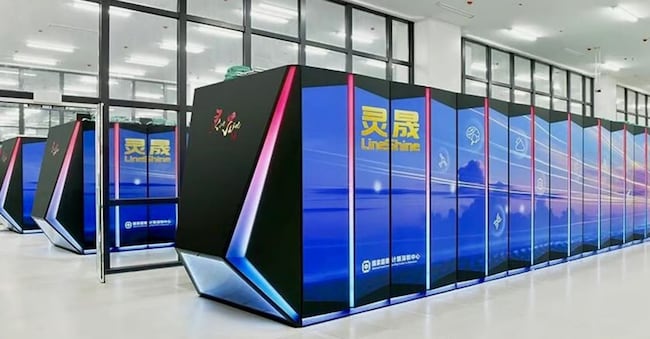
The world’s most powerful supercomputer is Chinese. The 67th edition of the TOP500 list crowns LineShine, a supercomputer operating in Shenzhen, which has taken the top spot from the American El Capitan. LineShine is the first Chinese-based system to top the TOP500 list since Sunway TaihuLight, another Chinese supercomputer that had claimed the top spot in 2017. After nine years, therefore, Beijing has returned to the global summit of high-performance computing.
China overtakes the US in supercomputing
LineShine is installed at the National Supercomputing Centre in Shenzhen, China, and was developed by the Shenzhen Cloud Computing Centre. It recorded a debut performance of 2.198 million million million operations per second (2.198 exaflops/s), outperforming the American El Capitan system by more than 20 per cent.
The Chinese system is based on the custom-built LingKun platform, featuring 304-core LX2 processors operating at 1.55 GHz, the proprietary LingQi interconnect and the Kylin OS operating system.
The rise of exascale supercomputers
LineShine is the fifth Exascale-class supercomputer to be commissioned worldwide. El Capitan (California, United States), Frontier (Tennessee, United States), Aurora (Illinois, USA) and JUPITER Booster (Germany) are all Exascale-class systems and rank, respectively, from second to fifth in the global rankings.
What is exascale computing (and what is it used for)?
A supercomputer is described as exascale-class if it is capable of performing at least 1 billion billion operations per second, or, to put it another way, one exaflop of floating-point operations per second. The advantages of exascale computing are linked to ability to solve intractable problems. For example, exascale computing offers the power needed to determine the origins of chemical elements, develop new processors, analyse unstable substances and materials, validate the laws of nature and exploring particle physics.


