
Chinese cars: a slumping domestic market and a price war are driving consolidation
Falling sales, too many brands and declining prices are the key challenges facing the world’s largest car market

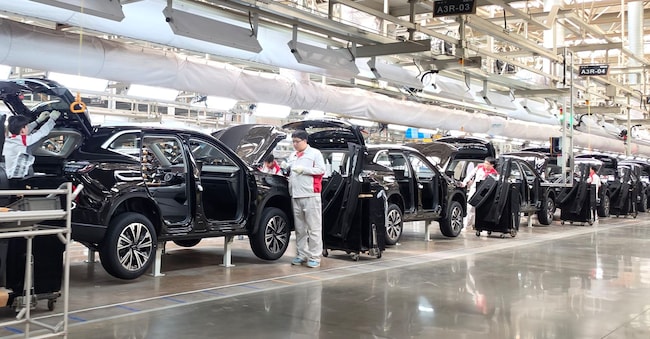
The script had already been written, and the first signs had been visible since the early months of this year. The Chinese market, the world’s largest, is now dominated by local brands and has entered a phase characterised by three phenomena: falling sales, a price war and the consolidation of corporate groups. Is this a crisis?
No, not exactly. But China, as an automotive superpower, is certainly opening a new chapter which obviously has short-term implications for the share prices of car manufacturers too. Let’s take it in order: in August, new car registrations in China fell by 24 per cent compared with the previous year, totalling 1.5 million. Quite apart from the fact that China’s monthly volume, even at this lower level, is equivalent to the entire Italian market for a year (which serves to highlight the sheer scale of the automotive sector in China), this is nonetheless a sharp decline. However, it does not come as a surprise: AlixPartners had already predicted before the summer that car sales in China by the end of 2026 could fall by 10 per cent, dropping to 24.6 million units. According to Dario Duse, Head of EMEA for AlixPartners’ Automotive team, ‘the Chinese market, for the first time in many years, is contracting sharply: down 18 per cent in the first four months, with a partial recovery in recent months but still in negative territory. This is due both to the withdrawal of incentives and to trends in the economy and the property market, which even for the Chinese is an important indicator of wealth and whose decline suggests a need for caution.”
Lower domestic sales mean lower turnover and lower profit margins (and the stock markets do not like this), but above all they are driving manufacturers to vigorously seek export markets; as a result, growth of up to 10 million vehicles is forecast for 2026. And the rapid advance across the Old Continent is plain for all to see, putting pressure on traditional European manufacturers (the Volkswagen Group and Stellantis in particular), whilst also eroding the room for manoeuvre of Japanese and Korean manufacturers. But speaking of the latter, it is worth noting that, in an automotive landscape subject to constant upheavals and upheavals, Toyota, despite facing difficulties in terms of revenue and profits, remains the world’s leading manufacturer, whilst the Hyundai Group, in third place, is enjoying a period of solid growth and forecasts an increase in volumes and an operating margin of 7.3 per cent for 2026. Clearly, the South Korean group, which includes Kia, has got its act together on key issues: electrification, software and competitive positioning.
But let’s return to China: according to Dario Duse, the increase in exports will not offset the combination of falling domestic demand, the relocation of further production capacity outside China (3.4 million vehicles by 2030) and a reduction in incentives within a given context.
As mentioned, the domestic Chinese market is currently witnessing a price war, with across-the-board price cuts from all manufacturers averaging 18 per cent. This competition is also the flip side of the coin of inevitable consolidation. Natural selection is taking hold in China. Too many brands, with very low sales volumes, cannot survive. For example, according to AlixPartners, in 2025 there were more than 140 manufacturers of eco-friendly vehicles in operation, of which more than 110 had annual sales of fewer than 100,000 vehicles and total average registrations of fewer than 90,000 vehicles per year. This is far too few for an industry which, despite the cost advantages of a national system that synergistically supports the sector, still requires substantial investment, particularly at the cutting edge of artificial intelligence and software-defined vehicles. Inevitably – though the alarm has long been sounded – there will be a sharp wave of consolidation, and this will impact Europe, where Chinese players are flooding the market with brands and models in a continuous stream, as if they were low-cost smartphones; as long as they capitalise on the balance between quality (generally high) and price (affordable), they will continue to gain market share; but just round the corner, after the initial wave, lies the stumbling block of residual value and the ability to retain customers – perhaps the very same customers they have poached from the major German manufacturers.


