Products

China's artificial intelligence strategy scares the US. The case of Qwen 2.5

Some American newspapers, with CNBC in the lead, fear that Chinese artificial intelligence models, already very popular on the Red Continent, are ready for the big leap

by Luca Tremolada

(Alamy Stock Photo / Reuters)

4' min read

4' min read

China is close, and too close if we move into the field of generative artificial intelligence. Some American newspapers, with CNBC in the lead, fear that Chinese artificial intelligence models, already very popular on the Red Continent, are poised for the big leap by overtaking those of the United States both in terms of performance and diffusion.

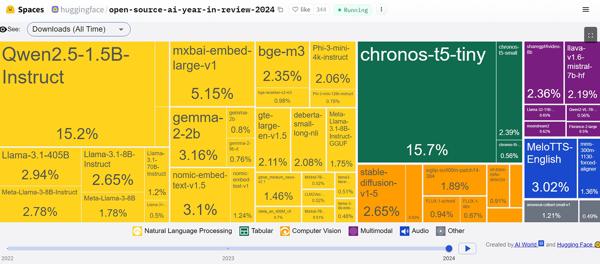
A sign of this comes from Hugging Face, the world's most popular open-source platform of LLM (large language models), where one can find tools and resources for working with generative AI and computer vision. In there you can find Meta's Llama 3, Google's Gemma and Elon Musk's Grok, all open AI models, i.e. they can be freely downloaded, used and distributed. They are an alternative to closed source models such as ChatGpt, Microsoft Copilot and Gemini.

Loading...

Well, in the last three months, Qwen2.5 has appeared in the ranking of the most downloaded LLMs, reaching 94 million downloads in just three months, making it the most popular model. Created by Alibaba Cloud, one of the world's leading cloud computing and artificial intelligence providers, it dominates the Hugging Face ranking followed by Meta's Llama family and Google's Gemma. Qwen's success has surprised more than one technology analyst but perhaps it has a technological reason.
Over the past 18 months, other Chinese giants such as Tencent and ByteDance, the company behind TikTok, have also launched their own artificial intelligence models. In addition to Gwen, there is Baidu's Ernie Bot, which promises to rival ChatGpt even though it appears to be far behind. Last year, Tencent launched its own founding model called Hunyuan. US magazines say it specialises in advanced reasoning and can support image creation and text recognition. Huawei took a slightly different approach to its rivals with its Pangu AI models. It has created a number of AI models aimed at customers in specific sectors, including government, finance, manufacturing, mining and meteorology. While the latest entrant, ByteDance's Dubao chatbot would in a very short time surpass rival Ernie Bot in popularity. Those who have even got their hands on the free version have judged that the gap with the Ai of the West remains even if the distances are shortening.

Running against the US is not easy. Beijing has strict requirements for artificial intelligence models and their use.

It is no mystery, in fact, that the main producers of generative artificial intelligence are all stars and stripes Moreover, Washington's blockade of Beijing over Nvidia's chips, which to date are the most advanced for learning generative AI algorithms, represents a bottleneck to China's progress in this field. To put it another way, the American advantage is as of today out of the question.

Qwen's success, on the other hand, seems partly related to its size. In fact, we are talking about a 1.5 billion parameter model. ChatGPT 3.5, the chatbot that debuted in 2022, had 175 billion, and the current one, GPT-4o, is even bigger. We are therefore talking, in the case of Qwen, about a very small model that can be downloaded even on the cheapest smartphones of 2024. It does not need to connect to external servers, but can be run locally, so it does not share information outside the device. In essence, it does what ChatGPT does, but in a much more limited way: it answers questions with natural language.

It supports over 29 languages, including Italian, English, French, Spanish, German, Russian, Japanese and Korean, and can manage up to 32,768 tokens and generate texts of up to 8,192 tokens. In simple terms, tokens correspond to pieces of words, where 1,000 tokens are roughly equivalent to 750 words.

Technologically, it is not something new.

Qwen is successful precisely because, as many people on Reddit suggest, especially in third world countries, they no longer own a computer, but only a smartphone, usually with little memory. And these small, open systems are perfect. On the ball, of course, are not only the Chinese but also Big Tech itself, which have added smaller, open and free versions to their proprietary models. As in the case of Google, which in addition to Gemini has Gemma.

So it is not necessarily the case that open source is the focus of China's strategy. On the contrary, it is by no means certain that in the short term the goal is to compete on an equal footing with US Big Tech. Trump can rest easy but up to a point because the challenge will not be a flagship one. We are not witnessing a race but a marathon. Technological development in the Red Continent, as anyone who has studied this country closely (and for some time) knows, never proceeds at a breakneck pace. And it is never what you expect. There has been concern in recent weeks about the news that the Chinese army has started using an adapted version of the American Meta's open source artificial intelligence Llama for military purposes. Those expecting a compact and flagship advance might be disappointed. China in Ai seems increasingly ecumenical and agnostic. To be near and close, but not in the way you expect.

Copyright reserved ©
  • Luca Tremolada

    Luca TremoladaGiornalista

    Luogo: Milano via Monte Rosa 91

    Lingue parlate: Inglese, Francese

    Argomenti: Tecnologia, scienza, finanza, startup, dati

    Premi: Premio Gabriele Lanfredini sull’informazione; Premio giornalistico State Street, categoria "Innovation"; DStars 2019, categoria journalism

Loading...

Brand connect

Loading...

Newsletter

Notizie e approfondimenti sugli avvenimenti politici, economici e finanziari.

Iscriviti