
Chorus Life, Bergamo inaugurates its 'smart district
The district, resulting from the regeneration of the former Ote industrial area, was built by Costim and the Bosatelli family and designed by architect Joseph Di Pasquale. It cost about half a billion, generating an economic spin-off in the area of more than one billion euro
3' min read
Key points
3' min read
An urban project born from the vision of an enlightened developer. An urban regeneration plan (with private financing of around half a billion euro by the Bosatelli family) that has converted the former Ote industrial area in Bergamo, generating an economic spin-off in the area of more than 1 billion euro and, in perspective, providing 500 new jobs. This is ChorusLife, which opened its doors to the city yesterday, and which was realised by the Polifin Group and its subsidiaries: Costim (Impresa Percassi, Gualini and Elmet) and Gewiss. A story that has seen Bergamo and Italian companies in the field, excellences of Made in Italy, combining innovation, quality and sustainability, making ChorusLife a unicum (replicable in the promoters' idea) and a symbol of innovation in the construction industry.
The Origins and the Project
This story started ten years ago, from an idea of the knight Domenico Bosatelli and structured with the design of architect Joseph Di Pasquale. Davide Albertini Petroni, ceo of Costim since January 2024, says that "in urban regeneration projects there is great responsibility, and the Bosatelli family has been able to physically translate the concept of urban regeneration: a disused industrial area has been taken over, it has been reclaimed, polluted land has been removed, the area has been equipped with an infrastructural system, green areas have been increased, and the new district," says the ceo, "is a piece of city of high architectural quality, with services, without barriers, that dialogues with the surrounding context. The energy performance is not secondary. It is an ESG compliant project'.
The new smart district is also the result of an inter-institutional collaboration with the Region, the Province, the Municipality and the TEB Company, which led to the signing of the Programme Agreement in 2018: an urban planning act that made it possible to start the most important private construction site in recent decades, in the area, which testifies to the effectiveness of public-private synergies. And the handover of the baton from former mayor Giorgio Gori to the new mayor Elena Carnevali was noted during the presentation. "An innovative space is coming to life that welcomes and invites people to enter a new and contemporary part of the city that we perhaps did not have until now, and, above all, of this size with residences and commercial activities, a large square dedicated to socialising, and a modern arena," said the first lady mayor, "capable of hosting events and shows that the city was lacking. A new epicentre that goes in the direction of a 'polycentric' city. The mayor highlighted the issue of impacts, reiterating that "it is a project without land consumption, with high environmental, energy and social standards. A new dynamic place for the city'.
The numbers
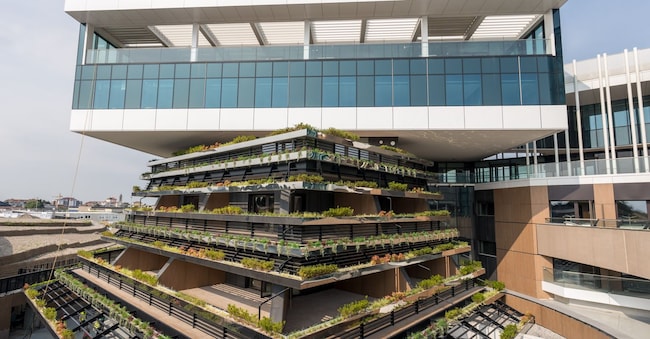
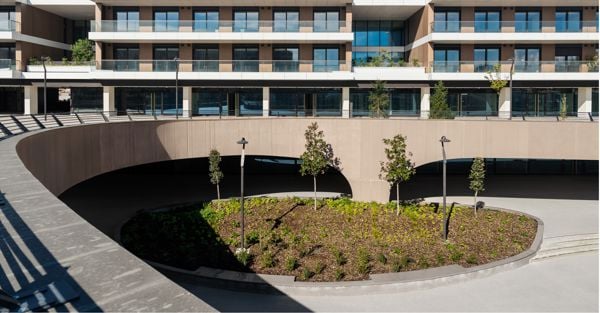
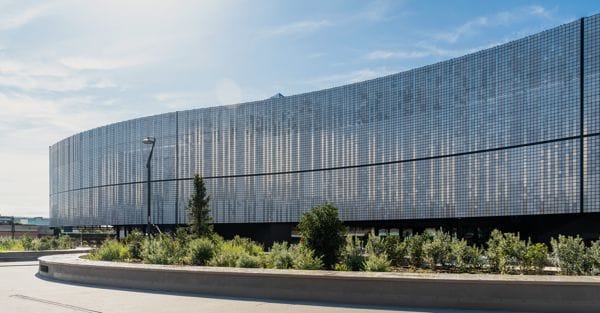
.Today, ChorusLife includes a residence with 74 lodgings, the city's first build-to-rent project, a four-star superior hotel, 107 rooms, with the prestigious Radisson sign, the ChorusLife Arena that can seat up to 6,500 with facades covered by a 'vibrating skin' certified by the Milan Polytechnic and patented in collaboration with the Gualini company - part of the Costim group - that built it and entrusted it to the management of the international giant ASM Global. In addition to all this, there is an urban spa and wellness centre of 8 thousand square metres, soon to be opened (the largest in Lombardy), commercial and catering activities for over 10 thousand square metres, and a series of squares, characterised by a succession of arches.
ChorusLife is not only an achievement for Bergamo: it is a replicable model. The skills, know-how and processes can in fact be exported to other urban realities. Costim for example presented, in collaboration with SEA, the Linate Airport District (LAD), which will transform the area adjacent to Linate Airport into a smart district connected to the Idroscalo. Work will begin in 2025 and end in 2028. Another project concerns the redevelopment of the area of the former Rodriquez shipyards in Pietra Ligure, to redesign 600 metres of waterfront. A third initiative is on the pipe line in Trieste, where Costim has presented a public-private partnership proposal for the urban regeneration of the Porto Vecchio area.

Brand connect


Newsletter RealEstate+
La newsletter premium dedicata al mondo del mercato immobiliare con inchieste esclusive, notizie, analisi ed approfondimenti
Abbonati