
Chris Pappas wins New Hampshire: a victory for the Democrats and a lead in the Senate
The Democrat from New Hampshire defeated the Republican John Sununu, winning a seat that is crucial to the balance of power in the Senate

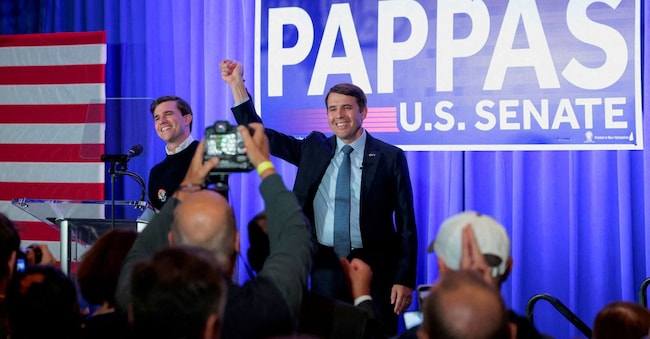
At the age of 46, Chris Pappas has made history in American politics. The Democratic MP for New Hampshire defeated Republican John E. Sununu in the Senate race, winning a hotly contested seat and becoming the first openly gay man to be elected to the Senate. This victory has dual significance: on the one hand, it allows the Democrats to retain a seat considered crucial to the balance of power in Congress; on the other, it marks a historic milestone for the representation of the LGBTQ+ community in American politics.
Pappas will succeed the Democrat Jeanne Shaheen, who had announced her decision not to stand for re-election after three terms. His entry into the Senate marks a further step forward from 2013, when Tammy Baldwin, a Democrat from Wisconsin, became the first openly lesbian senator. Before Pappas, Kyrsten Sinema, elected in Arizona in 2018, had also been a member of the LGBTQ+ community in the Senate, but the New Hampshire representative is the first openly gay man to win a seat in the Senate.
Born and raised in Manchester, New Hampshire, Pappas’s political career is deeply rooted in his home state. After graduating from Harvard, he returned to his hometown to work in the family restaurant, the Puritan Backroom, a business that opened in 1917 and has become a local institution. From there, he began his career in public office: first in the State House of Representatives, then in various administrative roles, until his election to Congress in 2018. Since 2019, he has represented New Hampshire’s first congressional district – one of the most competitive in the state – for four terms.
Politically, Pappas is regarded as a moderate Democrat, with a pragmatic style and a penchant for bipartisan dialogue. During his time in the House of Representatives, he has on several occasions voted against his own party. At the same time, he has championed various civil rights causes: as co-chair of the Congressional Equality Caucus, he has promoted legislative initiatives to protect the LGBTQ+ community. He has also received support from organisations committed to defending reproductive rights and workers’ rights.
Her homosexuality was not the focus of the election campaign. Pappas chose to focus his message on voters’ priorities, avoiding turning his candidacy into a battle over identity. However, he did not hide his private life: in the video in which he announced his candidacy, he appeared alongside his husband, Vann Bentley, with whom he shared a tender moment. ‘The reality I live in today is something I would never have thought possible when I was growing up, just a few decades ago,’ he said during the campaign. ‘My state, our country, have come a long way.’


