
Christopher's love of life
Matteo Bianchi's new collection of poems, published by Interlinea, privileges the angle of fragility and weaknesses

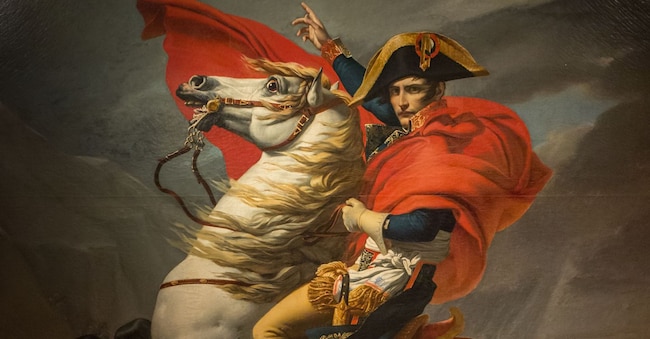
Giancarlo Pontiggia is right when, in his presentation of Matteo Bianchi's new poetic work, Christopher (Interlinea, 112 pp., €16), he writes that we do not know exactly who his protagonist is - Christopher, in fact - and that, however, it matters little: because "more significant" is the "coupling" between the various sections of the book, in which the figure of Christopher is put in relation with other, apparently very different, figures - namely that of Roberto Pazzi, an intellectual who was always secluded but among the most significant of recent years, who died in 2023, and that of none other than Napoleon. In fact, Pazzi and Napoleon can also be considered protagonists of the book, even though they are not present in the title; and so the point is to understand, if anything, what might have led Bianchi to assimilate similar trajectories, what common zones of light or shadow he glimpsed in them.
Fools and Napoleon
What can hold together the destiny of an artist whose life seems to have been marked above all by the pains of 'humiliation, misery, abandonment', as Tommaso Di Dio summarises in the final critical note, with those of two men like Pazzi and like Napoleon? Bianchi does not explain it to us, of course, because Christopher is not an essay: it is a poetic work (regardless of the presence of pages also in prose, almost narrative). But the answer lies in the chosen angle of vision: the tale not of great deeds, but of frailty and weakness. Bianchi, precisely because he is a poet, is interested not in life exposed but in life naked, hidden: and therefore life in its intimate truth, rather than in its worldly representation.
Agreed: in Christopher's case, one senses, naked life and exposed life tended to coincide. His seems to have been a fragile life tout court, or even a life devoted to fragility right from the start, if it is true that even as a child he 'cried when he saw' the soap bubbles 'that were half-tightened to the table/waiting to burst, to disappear'. Not that he wasn't also happy, Christopher: it's that 'happy and unhappy' he was 'equally so'. Inhabiting him, according to Bianchi (whose sensibility has always been characterised by a skin-deep sensitivity), was 'the fear/of carrying within himself every hope,/the seeds of a purer life./Unless it was fear of himself/that forced him to retreat/to a mere survival'. But in the case of Pazzi and Napoleon, the choice could have been different: and yet the one, Pazzi, we see here portrayed in bed, 'as he sank into his shroud/wearing only a polo shirt/salvaged, but still Lacoste'; the other, Napoleon, in the moment of solitude rather than glory - or rather in that of awareness that 'a soldier is only a man and that a man is not only a soldier'. As if to remind us that, in the face of History, in reality there is no difference between the humble and the powerful: the deeds of kings, as Carlo Ginzburg observed, in the end count as much as the thoughts of the masons of Thebes.
But more than anything else it is a great act of love towards life in all its forms, Christopher. And everything is held in a fourth figure who appears on the scene at the book's close, almost as if to definitively validate its meaning: the figure of the father, 'my father', in turn portrayed through images of weakness, almost of surrender. "He doesn't want to shave anymore and starts to make a fuss", we read in the epilogue lines, "he never takes off his red tie under his blue dressing gown and believes he is Napoleon". He is 'afraid for him', Bianchi, and for all those who cannot 'change course': these are the concluding words.
Matteo Bianchi, Christopher, Interlinea, 112 pp., € 16

