
China’s economy slows: industrial output falls to 4.5% in July
Sales, fixed investment, house prices and unemployment are also among the issues to be resolved ahead of the October Plenum

The most politically sensitive economic data imaginable has hit the Chinese leadership whilst they are on an informal retreat at the seaside resort of Beidahe. Industrial output, sales, fixed-asset investment, house prices, unemployment: the issues to be resolved ahead of the October Plenum are becoming increasingly intractable in the face of July’s disappointing figures.
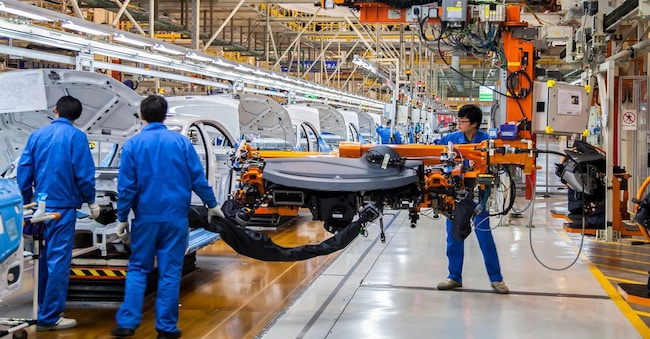
Chinese output grew by just 4.5 per cent year-on-year, slowing from 5.3 per cent in June – the fastest growth in the last three months – and falling short of expectations of 5.0 per cent, due to weak domestic demand and extreme weather events. The slowdown came against a backdrop of weaker growth in the manufacturing sector (5.5% compared with 6.0% in June), where 25 of the 41 major industries recorded growth, including computers and communications equipment (19.1%), railways and shipbuilding (13.6 per cent), general equipment (9.5 per cent), specialised equipment (12.6 per cent) and electrical machinery (5.3 per cent). Conversely, output fell in the chemicals sector (-1.2 per cent), the coal sector (-10.8 per cent) and the non-metallic mineral products sector (-3.3 per cent).
Retail sales
Retail sales rose by 0.6 per cent year-on-year in July 2026, slowing from the 1 per cent growth recorded in June and falling well short of expectations of a 1.5 per cent year-on-year increase. Car sales fell by 17.0 per cent, whilst retail sales rose by 2.5 per cent. Sales of petroleum products (-7.6 per cent), furniture (-8.8 per cent) and building materials (-14.2 per cent) were down. By contrast, sales of communications equipment rose by 20.4 per cent. By sector, catering revenue rose by 1.4 per cent, whilst retail sales of goods rose by 0.5 per cent. Online sales of goods rose by 4.6 per cent in the first seven months.
Worse still, China’s investment in fixed assets fell by 6.7 per cent year-on-year in the January–July 2026 period; the market had anticipated a figure somewhere between the 6.2 per cent decline and the 5.7 per cent decline recorded in the first half of the year. Property investment therefore remains the real stumbling block, having fallen by 19.2 per cent following an 18 per cent decline in the January–June period, whilst infrastructure investment (-3.6 per cent compared with -2.4 per cent) and investment in the manufacturing sector (-1.7 per cent compared with -1.2 per cent) also fell. Excluding the property sector, investment in fixed assets fell by 5.7% in January–July, marking a further decline compared with the 2.7% recorded in the first six months of the year. On a monthly basis, investment in fixed assets fell by 1.42 per cent in July, a sharper decline than the 0.37 per cent drop in the previous month.
Property
Prices of new homes in 70 cities fell by 3.2 per cent year-on-year in July 2026, following a 3.3 per cent decline the previous month. This marks the 37th consecutive month of decline. Among the major cities, prices continued to fall in Beijing (-2.3% compared with -2.1% in June), Guangzhou (-2.2% compared with -2.6%), Shenzhen (-2.9% compared with -3.6%), Chongqing (-3.7 per cent compared with -4.2 per cent) and Tianjin (-4.4 per cent compared with -4.6 per cent). Shanghai remained the clear leader, with new house prices rising by 3.0 per cent, only slightly slower than the 3.1 per cent increase in June. On a month-on-month basis, new house prices fell by 0.1 per cent, in line with the decline in June.


