
Cinisi cow as brand, now Cinisi launches production bet
3' min read
3' min read
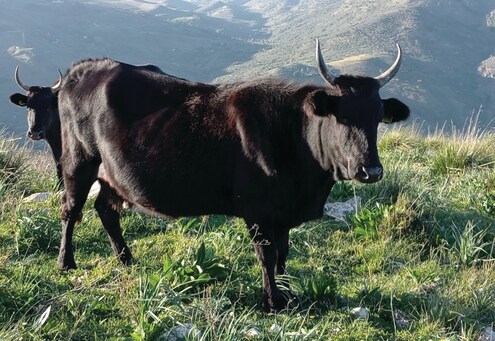
Starting again from an identity animal to rebuild a system, a supply chain and, why not, a positive brand. The animal is the Cinisara cow, the place is Cinisi (hence the animal's name), the project is by the municipal administration led by Vera Abate, who emphasises: 'The Cinisara cow is not just a breed of cattle, but a living part of our identity. It is a resource that we must protect, promote and above all pass on to future generations'. And this is the starting point in a strategy that aims to network, to seek and find alliances to give a different signal to a community like Cinsi, which is trying to shake off the ugly name of being the town of don Tano Badalamenti, the now deceased boss, of being mafia land and the town of Peppino Impastato, killed by the mafia because he was annoying with his enquiries and public accusations from Radio 100passi to 'sitting don Tano', Badalamenti in fact.
The Cinisi administration is therefore starting again from territorial identities to indicate a productive path in legality: there is the prickly pear and there is the cinisara cow, a breed of cattle that is a flagship of sustainability, which resists climate change, thanks to its tenacity and adaptability, and which is a guarantee of the highest quality in the products derived from it.
Loading...
An animal that is reared for almost its entire life cycle in the open air, on impervious and steep terrain, even impossible to cultivate, where it is not only perfectly at ease, but is able to draw essential nutrients from the little vegetation it can find and this gives its derivative products, from cheese to meat, a strong and absolutely unique flavour. Cinisi's administrators are well aware that in order to win challenges it is necessary to network and they have fully grasped the opportunities offered by the Cinisara's Chain project, financed with funds from the Sicilian Psr, carried out by the Consortium for the protection of the Cinisara cow. 'A project that started four years ago and we did not know where we could get to,' says Giuseppe Ingraffia, president of the Consortium, 'we farmers had a single and shared objective, to obtain results that would allow us to act accordingly to make Cinisara and its qualities known. The project aims to relaunch an indigenous breed through a transparent and sustainable supply chain. To achieve this goal, it is intended to build a business network that brings together breeders, researchers and professionals in the sector, with the aim of upgrading a long-neglected production sector. At the heart of the initiative is the development of a strict production specification, designed to guarantee high quality standards and increase the identity and visibility of the product on the market.
In the meantime, the municipality of Cinisi, where a dozen breeders are active, is moving to do its part: 'We plan to hold the Cinese cow fair in September,' says Vera Abate. We plan to invest in a consortium dairy and then we have created an item in the budget that concerns the Cinisi cow: we have set aside sums precisely to start doing a job that will lead us to guarantee a future for these Cinisi breeders'. There seems to be a clear awareness that work must be carried out to rebuild a production fabric that has ended up in the margins, despite the quality characteristics it possesses. 'The Cinisi cattle breed represents the future,' says veterinary surgeon Santo Caracappa. And there are not many breeds that manage to survive in certain soil conditions and with very little water: 'A system at risk, because it is carried out by many small companies that struggle, especially in the face of high production costs, but which guarantees a very high degree of craftsmanship in the product. These animals make it possible to manage environments that otherwise could not be exploited,' explains Gabriele Volpato, University of Gastronomic Sciences of Pollenzo. And the fact that they live in those conditions improves the quality of the meat: 'It has ecceptional organoleptic and taste qualities,' says Gianvito Gaglio, chef at the Massimo's I Giandini restaurant, located inside Palermo's Teatro Massimo and town councillor in Cinisi, 'and it is a product with all the characteristics of Sicilianity, of our environment, of our world. It is a matter of reconstructing a productive fabric not only in Cinisi, of course, but in all the towns of Palermo and Sicily where there are still those who breed the Cinisi cow'.
Copyright reserved ©


Brand connect
Loading...
