
Five paths, one destination: Italy to be discovered at a slow pace
There is an Italia that only reveals itself to those who travel through it slowly. One encounters it in the silence of an abbey reached on foot, in the rhythm of the pace that crosses the Apennine valleys, in the small villages of Lazio where one stops in the evening. These are the five great historical and religious paths that cross the country and all converge on Rome, after crossing Lazio. Heritage of European importance, today at the centre of an integrated action of valorisation, they return an idea of travel made of slowness, listening and crossing.
Via Francigena. Italia's most internationally recognised route, certified as a Council of Europe Cultural Itinerary in 1994. It is based on the diary of Archbishop Sigeric of Canterbury, who in 990 A.D. noted down the 79 stages of his return from Rome in a manuscript now in the British Library. The Italia section measures about 1,000 kilometres in 45 stages, from the Great St. Bernard Pass to Rome. In Lazio it crosses through the Tuscia viterbese: Bolsena - where the Eucharistic miracle that inspired the feast of Corpus Domini took place in 1263 - Montefiascone with its Rocca dei Papi, Viterbo (ancient papal seat), Vetralla, Sutri with its Roman amphitheatre carved into the tuff, Campagnano and La Storta, up to St. Peter's Basilica. The management is entrusted to the European Association of Vie Francigene (AEVF).
Francis Way. It links the most significant places in the life of Francis of Assisi (1182-1226). It is divided into two routes: the Via del Nord, about 190 kilometres from the Sanctuary of La Verna to Assisi; and the Via del Sud, about 300 kilometres in 13 stages from Rome to Assisi through the Sabine countryside and the Sacred Reatine Valley, the heart of Franciscan spirituality. Within a radius of just a few kilometres are the four sanctuaries that preserve the memory of the most important moments in the Saint's life: Greccio, where in 1223 Francis made the first nativity scene in history; Fonte Colombo, where he dictated the Rule of the Order; La Foresta, site of the miracle of the grapes; Poggio Bustone, where he received the revelation of the forgiveness of sins. The stigmata were received at La Verna in 1224. At the end, at the Basilica of St Francis of Assisi, the Testimonium is issued.
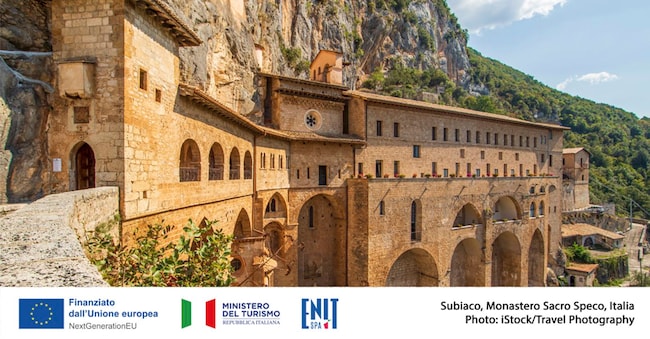
St. Benedict's Path. It links the three fundamental places in the life of the founder of western monasticism: Norcia, his birthplace (around 480 A.D.); Subiaco and Montecassino, both in Lazio. The route covers about 300 kilometres in 16 stages between Umbria and Lazio, through the Sibillini, Reatini, Simbruini, Lucretili and Ernici mountains. In Subiaco, the Sacro Speco guards the cave where Benedict lived for over thirty years in hermitage, and the Abbey of Santa Scolastica housed the first active printing press in Italia in 1465. In Montecassino, around 529, he founded the abbey that is still the heart of the Benedictine Order today. Benedict of Norcia has been the patron saint of Europe since 1964, by proclamation of Paul VI with the apostolic letter Pacis nuntius.
Romea Strata. The most recent certified Cultural Route of the Council of Europe, with recognition awarded on 17 June 2025. It reconstructs the network of routes that led pilgrims from Central Eastern Europe and the Baltics to Rome: over 4,700 kilometres through seven countries, with 245 stages and more than fifty UNESCO sites. The main section in Italia covers about 1,000 kilometres in 47 stages and in Lazio also touches on Bolsena, Montefiascone, Viterbo and San Martino al Cimino, arriving in Rome to crown the journey. Since 2024, the final section no longer rejoins the Via Francigena: a meticulous remapping job carried out by a network of volunteers has redefined the route, giving it a distinct route identity and an unprecedented entrance to Rome.
Via Romea Germanica. Certified Council of Europe Cultural Route in 2020. It reconstructs the journey described by Abbot Albert of Stade in the Annales Stadenses of 1236, a text structured as a dialogue between two monks discussing the best way to Rome and which has become one of the most accurate medieval travel accounts preserved. The stretch in Italia measures approximately 1,050 kilometres from the Brenner Pass to Rome. In Latium it joins the Via Francigena in Montefiascone, and from that point the two paths become one: together they pass through Bolsena, Viterbo - with the Macchina di Santa Rosa, recognised by UNESCO as an intangible heritage of humanity - Vetralla, Sutri and the Veio Regional Park, as far as La Storta. A variant in northern Latium also touches on Civita di Bagnoregio, the famous 'dying city' suspended on a tufa spur in the heart of Tuscia.
Five routes, one direction: Latium and Rome, Italy to be discovered on foot.
- Project financed by the European Union - Next Generation EU "Antichi Cammini d'Italia", PNRR - Mission M1C3 Investment 4.3 Intervention 274 - implementing entity MINISTRY OF TOURISM, executing entity ENIT S.p.A.

