
Circular economy, how to turn old sports equipment into social inclusion
This is what Rigenera Sport Ets, a Bologna-based reality, does by applying the principles of circular economy to the world of sport so as to make it accessible to all

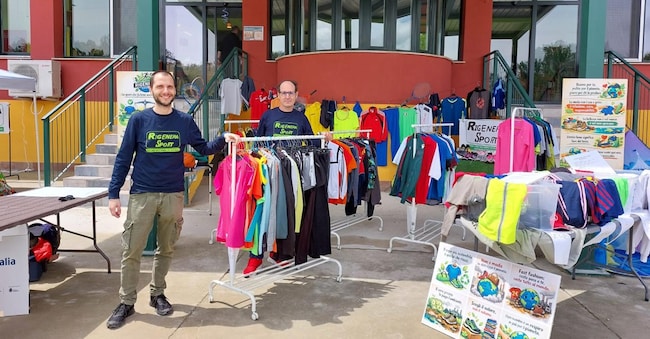
A football shirt forgotten in a locker room, a pair of running shoes that ended up in the back of a cupboard, a racket that is no longer used. Common objects, often destined for the dustbin. But which, in the right hands, can be transformed into tools for inclusion, CO2 savings and social support. This is the idea behind Rigenera Sport Ets, a Bologna-based company that applies the principles of the circular economy to the world of sport, with a clear objective: to make sport accessible, sustainable and supportive.
The way it works is simple: recover sports clothing and equipment in good condition and put them back into circulation, avoiding waste and offering new opportunities. Just donations, exchanges and solidarity towards those who cannot afford to play sport and who, thanks to the material and equipment received, can start practising it. Underlying this is an organised model, made up of volunteers, territorial referents and a short supply chain that allows redistribution in the same territory where it is collected.
How Rigenera Sport is structured
The Rigenera Sport network involves schools, sports associations, companies and families. Every week, white containers with the association's logo collect jerseys, shoes, balls, backpacks, sweatshirts, gym equipment. The material is selected and delivered to associations, family homes, social cooperatives, centres for minors, prison facilities. A network of donor and beneficiary partners that is constantly growing and allows for a rapid and concrete response to the needs of the territory.
Alongside the stable collection, Rigenera Sport is developing the project Swap party Sportivo, the free exchange event that turns reuse into a collective gesture. Here, students, families and athletes bring what they do not use of sports clothing or equipment and take what they need in exchange. "It is not just a collection moment," explained the president of Rigenera Sport Ets Renato Sebastianelli, "It is a civic, environmental and solidarity education workshop, where one learns that sustainability is not theory, but a daily habit. A garrison that can be replicated several times a year, capable of generating community and awareness'.
Environmental Sustainability
The environmental impact is far from marginal. Each garment reused avoids the production of a new article and therefore kilograms of CO2: a sports shirt is worth about 9 kg of emissions saved, a sweatshirt 10 kg, a pair of shoes over 12 kg. Small numbers if taken individually, but huge when multiplied by hundreds of pieces recovered each month. Added to this is the reduction of waste and raw material consumption, in line with the European circular economy objectives also represented by the well-known Agenda 2030.

