
Cities at 30 km per hour, savings of 150 million in six months
In the Report presented on 20 November in Rome all the data on the mobility of Italians with a focus on 'Zone 30'. Car dependency slows down public transport

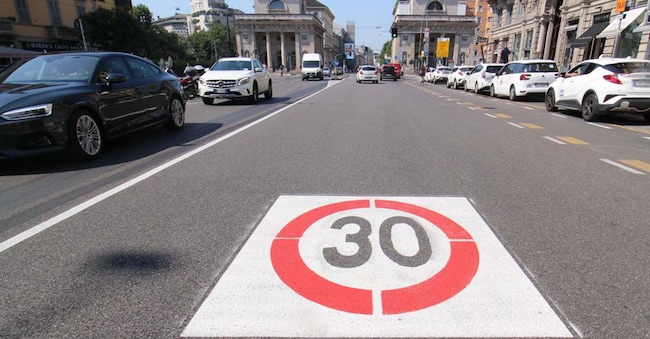
Reducing speed works. At least according to the assessments gathered by the 22nd Audimob Isfort Report on the experience of Bologna, the first major Italian city to organically apply the 30 km/h limit. They had renamed it 'city 30' with an experiment launched by the Municipality of Bologna on 16 January 2024: in large areas of the city, the maximum speed allowed by vehicles was lowered by 20 km/h, from the old 50 to 30 precisely. Today, almost 12 months later, the transport study centre draws a line. And it indicates abrupt braking halved, abnormal acceleration down by a third, emissions reduced by up to 17 per cent and travel times essentially unchanged: less than 30 seconds more for ten-minute journeys. A combination of effects that, according to estimates, translates into more than 150 million euros of avoided social costs in six months between collisions, injuries and risk situations.
The international picture: slow cities and livelier neighbourhoods
Isfort's analyses place 'Zone 30' within an international trend that is changing the use of urban space. Barcelona with the 'superillas', Paris with the 'ville du quart d'heure', London with the 'Healthy Streets' strategy: different models, but converging in reducing average speed, restoring centrality to neighbourhoods, shortening daily journeys. It is a design that includes rethought traffic directions, cycle and bus lanes, street furniture, reorganised car parks and tactical urbanism. Initial European assessments indicate benefits on safety, noise and pollution, without disrupting travel times. Cities on a human scale, even for pedestrians. In the Audimob Report, Zones 30 are intertwined with 'Vision Zero', the European framework implemented by the National Road Safety Plan 2030, which aims to halve deaths and injuries within five years and reduce fatalities to zero by 2050. Speed reduction is one of the levers of the 'safe system' model, which is not limited to speed limits but includes infrastructure, education, controls, protection of the most vulnerable users and a different organisation of urban space. It is an approach that requires coordinated and continuous action, with intermediate targets set as early as 2027.
Italian cities: Bologna leads the way, more to come
For Isfort, Bologna today represents the most advanced experience, followed by experiments in Olbia, Cesena and limited interventions in cities such as Milan, Rome and Turin. The results in Bologna - falling emissions, more uniform traffic, a drastic reduction in risky manoeuvres - are prompting other municipalities (Florence, Bergamo) to consider a structural extension of the 30 km/h while waiting for a more organic national regulatory framework, on the model of Spain and Greece.
The Automobile Domain
But of course the Italian context is still struggling. And the car remains the barycentre of mobility: in the first half of 2025 it still absorbs 60.8% of journeys, despite a slight setback compared to 2023. It is a dominance that also weighs on intermodality, stationary at 2.8%, a far cry from the 6.5% recorded in 2019 and now supported almost exclusively by students. The Report points out how the lack of credible alternatives - particularly in the outer reaches of cities and in the South - keeps Italy within a rigid model, where the car is indispensable even for short journeys: 81% of journeys take place within ten kilometres and 73% remain within municipal boundaries. Added to this is a structural paradox: old, expensive cars, often stationary for more than 95% of the time and yet impossible to replace for families with fewer resources. In this framework, intermodality does not take off because it does not find the infrastructure to do so. Italy, Isfort summarises, moves over compact city distances with a dispersed city system.
Cost: the variable that weighs more than speed
The Audimob-Isfort Report also recalls the issue of costs, which remains the real critical point of Italian mobility. The car continues to be the most widely used vehicle, but also the most expensive: 334 euros per month per family, 105 billion a year in total expenditure (+14.5% in the 2020-2024 period). A circulating fleet that ages, remains stationary more than 95% of the time, and is increasingly expensive to maintain.


