
Città Salute, Lombardy Region covers extra costs with 300 million
In 2026, work was resumed by FINSO, Edison Next and Condotte 1880. In 2030 the 1.5 million services per year mega health centre.
Key points
- Resumption of work after negotiations on the new budget
- The goal of 700 beds and 3,000 doctors
- The mega health citadel the vision of Renzo Piano and Umberto Veronesi
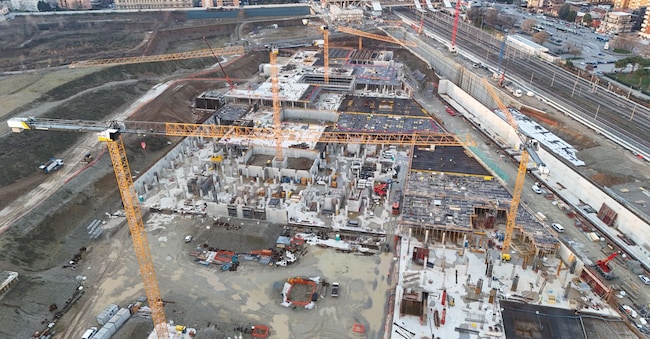
While Lombardy's healthcare system is being questioned, imbalances and treasuries included, workers have returned to the former Falck areas of Sesto San Giovanni. This time there was no ribbon-cutting ceremony and the building site opened last month without fanfare. On the other hand, there have been more than one announcement for what is to be the citadel of healthcare in Lombardy, which should bring together Besta and the tumour institute in a mega structure. An area of about 13 hectares, 4,000 square metres of greenery with 10,000 trees, a 24,000 square metre underground car park, where over 3,000 doctors and nurses will work. In all, 700 beds, 24 thousand admissions and over 1.5 million services per year.
Conceived way back in 2013, a legacy of the Formigoni era, from one postponement to the next it should have seen the light by the end of this year. Now the goal is set for 2030, 45 months of work entrusted to the newly formed company Cisar Costruzioni, of which FINSO has 51%, Condotte 1880 39% and Edison Next 10%. Then the management, which will have a contractual duration of 23 years, will be entrusted to two operating companies: the first, with Edison Next as leader with 51%, FINSO with 45% and Condotte 1880 with 4%, for the management and maintenance of the energy plants and the supply of thermal and electric energy; the second, with FINSO with 80%, Edison Next with 15% and Condotte 1880 with 5%, for catering, cleaning, waste management.
For what purpose? No comment is being made by the Lombardy region's welfare department at this time. On the other hand, the same operators recall the 'various slowdowns related to the intervening inflationary shock, from the pandemic to the conflict in Ukraine, as well as the variations of the executive project due also to the new framework of technical regulations'. After the end of the reclamation, excavation work had already started in 2024, but due to the high cost of materials, what had emerged immediately was an extra cost of several million euros. On 23 December last year, the update arrived: from the 328 million initially allocated, the figure rose to 560 million, with the Lombardy Region putting 300 million on the table with the 2025 budget adjustment.
The lion's share of the 500 million euro appropriations for the modernisation of public facilities and the purchase of electro-medical equipment, which also affected other facilities in Lombardy and which councillor Bertolaso described as 'targeted resources, structural interventions and updated equipment that will enable healthcare personnel to work better and more efficiently, with benefits for waiting lists'. In the light of budgetary fears, the pharaonic project seems to be jarring. But, on the other hand, no one wants to hear of yet another postponement or, worse, yet another recalculation of costs. Something that the geopolitical situation of these weeks is likely to make difficult.
"Participation in this project confirms FINSO's and the Fincantieri Group's commitment to the development of complex infrastructures with a high strategic value for the country," reiterates Salvatore Esposito, CEO of FINSO. The City of Health and Research in Sesto San Giovanni represents one of the largest and most innovative healthcare construction projects in Europe, in which engineering expertise, sustainability and advanced management models are integrated to ensure efficiency, service quality and operational continuity over the long term". Raffaele Bonardi, Director of Business to Government at Edison Next, the services and technologies platform headed by Edison, speaks of "a commitment to support Italian healthcare facilities in their evolution towards increasingly efficient and technologically advanced models, to the benefit of patients and professionals". Valter Mainetti, president of Condotte 1880, emphasises how "the new hospital structure represents a major intervention in Lombardy's healthcare system. All the more so with a cutting-edge project in terms of sustainability. The excellence of the two institutes in the oncology and neurology sectors housed in a single site will be able to develop further in terms of research, as well as attracting and hosting patients from all over Europe".

