
City transport, cars still win. Transition far away for poorer groups
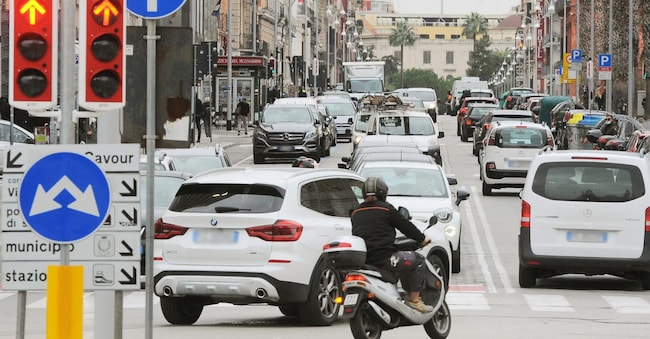
According to the analysis, 65% of Italians use a car to get around the city

3' min read
3' min read
It is a bitter confirmation that comes from the 21st report on mobility 'Audimob - Stiles and mobility behaviour of Italians' by Isfort, which will be presented today in Rome in collaboration with Cnel, with the scientific support of Agens and Asstra, and the support of Fnc, and which Il Sole24Ore anticipates. Cars remain the preferred choice for city travel, while intermodality in a sustainable key is increasing yes, but with minimal, almost negligible figures and in any case not capable on their own of affecting the mountain of four-wheeler travel.
Some trends
As far as 'green' transport is concerned, the first half of 2024 sees a recovery in sustainable mobility, with an improvement of almost 3 points compared to the first half of 2023. The most significant contribution comes from walking (+2.4%), followed by cycling/motorcycling (+0.3%) and public transport (+0.2%). But despite a mini-flexion in car use (-2.5%) the prospect of a modal rebalancing is still a long way off. Digging the furrow between private four-wheelers and sustainable transport, including PT, are the numbers: only a third of the population walks, uses buses or bicycles. All the others, almost 65% in 2023 and 63.1% in the first half of this year, use private cars.
"The central issue," says Carlo Carminucci, transport economist and director of research at Isfort, "is planning, urban transport policies, which unfortunately are still very much lacking: without a convincing alternative strategy to the more traditional and polluting forms of transport, little can be moved, a zero point.
local public transport
.The future then is not rosy, especially for local public transport. The Report follows Istat's estimates indicating a drop in population estimated at -4% to -8% by 2044 (almost 5 million fewer residents), depending on the more or less pessimistic scenario. And so "according to the model estimates of the 'Audimob' Observatory, there will be a -2% reduction in movements to 2034 and -7% to 2044 (median scenario); the greatest impact will be determined on the movements of the 14-19 year old class (-15% to 2034 and -28% to 2044,) but also the movements of workers will suffer a contraction of -6% to 2034 and -14% to 2044". And of course, public transport will suffer most.
"We then traced a trend linked to income," adds Carminucci, "a resounding and unprecedented aspect that pins the lowest income brackets to the use of private cars: it may seem like a paradox, but in reality it is an alarm bell that signals a worrying lack of services in the suburbs, forcing people to move around by their own means. The data speak for themselves and denounce that 72% of citizens who declare an average municipal income of up to 15 thousand euros use a car for their movements against the 15% who move around on foot, a percentage that rises by almost a point for the income brackets between 15 thousand and 20 thousand euros (in this case only 17% of the population use pedestrian mobility). As a result, the highest rate of sustainable mobility, 39.6%, can be found in the over 25,000 euro bracket, which is also the one that uses public transport more than the others (12.5%) and moves most of all on foot (21.6%). The same applies to the suburbs: here the share of active mobility falls below 20%, the share of public transport below 5%, while the weight of cars and motorbikes exceeds 75%.


