
Prada’s clarity and precision on the catwalk

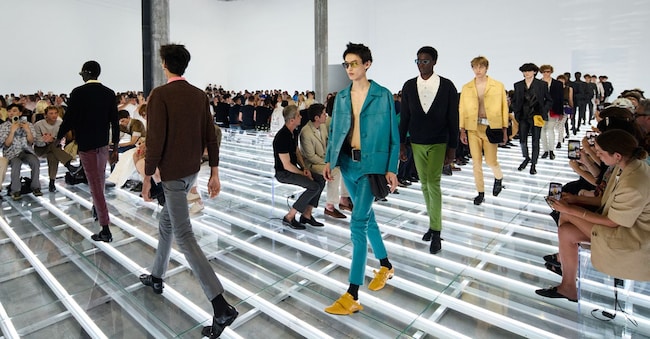
In an age of information overload, overstimulation and multi-channel abundance, making a definitive choice is a radical stance. When everything is possible, after all, nothing really is – this is certainly the case today, with the entire body of knowledge just a click away and history reduced to superficial synchrony – whilst the timeless modernist adage – ‘less is more’ – still holds true; indeed, it resonates louder and more resoundingly: absolute, incisive, uncompromising. This is what Miuccia Prada and Raf Simons firmly believe, naming their menswear show ‘clarity’ – clarity, of course, but also lucidity and discernment. The exact opposite of the postmodernist pastiche that is all the rage everywhere, the origins of which, paradoxically, are to be found precisely in certain particularly striking corners of Prada’s recent and past thinking. Changing one’s mind, after all, is a sign of intelligence, and Prada makes excellent use of this in its branding. ‘There’s too much of everything, a proliferation of messages that confuses,’ declare the creative directors backstage, practically in unison. ‘That’s why we’ve decided to focus on what is universal and absolute, and which, as such, transcends the wear and tear of time. We wanted to move away from technicalities and virtuosity, but also from decoration,’ emphasises Simons, vividly adding, ‘After all, pasta with tomato sauce is the simplest – and also the best.’ Rejection as a deliberate act, accompanied by a taste for repetition that refines the message rather than diluting it, translates on the catwalk into a raw, lanky, brutally youth-oriented, pared-back collection: by stripping away the unnecessary, the cuts become shrunken, bodies lose mass and grow gaunt, and age is frozen at adolescence. The clothes, on the other hand, are reinterpreted, rematerialised and reused archetypes: cigarette-cut five-pocket trousers and the denim jacket – worn as a shirt – in every material, from leather to transparent nylon; the bomber jacket and the blazer; the V-neck or crew-neck jumper. It is a compelling argument, not least because of the invitation extended to the end consumer to interpret the collection in their own way, but one that is marred by an underlying mannerism: an overly insistent focus on the work of the quintessential modernist reductionist, Helmut Lang, mixed, however, with the rebellious iconography of Karlheinz Weinberger, without metal fittings or trinkets but with a taste that, unfortunately, cries out for Hedi Slimane. The anti-establishment stance, fiercely contrarian, on the other hand, makes a strong impact, and with it the DIY spirit.
Simone Botte, better known as Simon Cracker, couldn’t care less about clarity. His upcycled world is proudly chaotic, messy and cobbled together. This season, it’s populated by scruffy brides – both male and female – who look as though they’ve emerged, looking splendid, from a rubbish bin. It’s a game Botte has been playing for some time. The aesthetic is now less punk and more realistic, but the approach seems to have stalled, clearly in need of a shift in new directions.
Francesco Saverio Matera is pursuing a rather unique creative endeavour with his young brand, Materia: adaptive fashion, designed to suit every body, including those with disabilities. His is a truly unique creative journey, inspired by his family experience – his brother is quadriplegic – which the designer, winner of the recent Cameramoda Fashion Trust award, pursues with vision and determination.
Moarno, the brand founded by brothers Gianmarco and Francesco Marano, is a small but well-established project that exudes an emotional quality all of its own, comprising garments that embody a shared heritage between the masculine and the feminine, with pure lines and tactile fabrics. A passion for craftsmanship and hard work shines through and remains a constant, and the result is understated yet poetic.
Domenico Orefice, despite his brand being just three years old, is stepping out of his personal comfort zone – dark, urban, defiant – to embrace the romance of brocades, the pragmatic precision of military greens, and the spontaneity of towels tied around the waist or across the chest. It is a step forward that is much appreciated, not least for the move away from the ‘formula’ – an approach that is rife elsewhere, yet is now on the wane.

