
Clean cooking, the domestic revolution that can help save millions of lives

According to the International Energy Agency (IEA), about one third of the world's population cooks their meals by rudimentary means, breathing in noxious fumes produced by wood, charcoal or agricultural waste. Between 2010 and 2022, progress has been remarkable: the number of people without access to clean cooking systems has fallen rapidly, from around 3 billion to 2.3 billion.
The most noticeable improvements have been in Asia and Latin America, thanks to national programmes that have distributed cleaner cookers free of charge and incentivised the purchase of fuels. Countries such as China, India and Indonesia have halved the population without access to clean cooking, aided by urban expansion and improved electricity grids. Between 2010 and 2022, in emerging and developing countries, the use of electricity as the main method of cooking tripled, partly due to the growing popularity of appliances such as kettles and rice cookers.
In recent years, however, progress has begun to slow down. The Covid pandemic and subsequent energy crisis are estimated to have pushed nearly 100 million households back to traditional cooking methods, especially in rural areas. According to projections based on current policies, there will still be 1.8 billion people without access to clean cooking systems in 2030.
In sub-Saharan Africa, in particular, the numbers are expected to remain broadly stable in the coming years, because the progress achieved is not sufficient to compensate for population growth. In the period 2010-2022, the uptake of clean cooking rose from 8% to over 15%, but the number of people excluded increased in absolute terms to about 1 billion.
Environment, health and gender issues: a cross-cutting goal
Universal access to clean cooking by 2030 is part of the goals of the UN Agenda 2030. According to estimates by the International Energy Agency, achieving it would entail a slight increase in energy demand in emerging and developing economies (less than 3%), offset by a 50% reduction in the use of fuelwood and coal. There would also be a positive effect on deforestation: 225 million hectares of forest - almost 6% of the global stock - would be saved, more than half of it in Africa.
The benefits of clean cooking are not limited to the environment: according to the World Health Organisation, the lack of clean cooking systems causes more than 3 million premature deaths each year and is linked to an increased risk of respiratory problems, cardiovascular disease and visual impairment caused by harmful smoke. Sub-Saharan Africa alone contributes 30% of the global burden of disease related to household air pollution, which mainly affects women and children.
In many communities, gender roles put women and girls in charge of preparing meals and collecting wood. According to the United Nations Development Programme, in sub-Saharan Africa these tasks take up an average of five hours a day - valuable time that could be devoted to education or activities that could provide economic independence. The search for wood also forces women to move away from villages, exposing them to the risk of aggression and gender-based violence. Cooking methods that reduce or eliminate the use of wood, while not solving the causes of these incidents, help to limit dangerous displacement.
Eni's initiative in sub-Saharan Africa
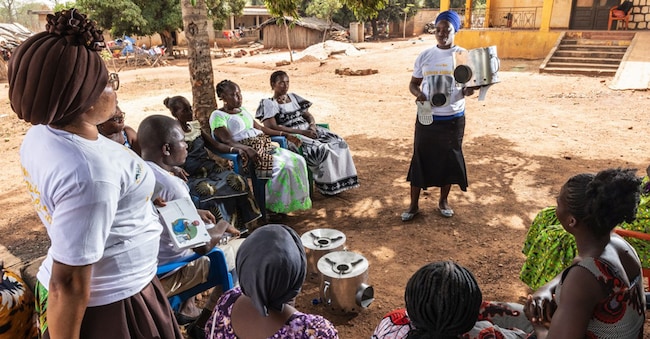
In 2018, Eni launched the Clean Cooking Programme, an ambitious initiative to promote the spread of clean cooking systems in sub-Saharan African countries. In the first phase of the programme, new-generation cookers, capable of reducing fuel consumption by more than 60% and drastically lowering harmful smoke emissions, were distributed free of charge.
These solutions offer immediate benefits and are easy to implement: in addition to being more efficient and cleaner, they enable households to save on fuel and reduce the risk of fires and household accidents. To today, some 2 million people have been reached in Côte d'Ivoire, Mozambique, Rwanda, Angola, the Republic of Congo and Tanzania, with the aim of getting to 10 million by 2027.
Starting in 2025, Eni will start distributing more advanced solutions free of charge, which will completely eliminate the use of wood and coal. Five pilot projects have already been launched to promote the use of electric induction cookers in Mozambique, the Republic of Congo, Rwanda and the Ivory Coast. In addition, a project between Mozambique and Côte d'Ivoire is being evaluated to distribute gasification cookers: a technology that, compared to traditional combustion, generates a cleaner gas and ensures greater energy efficiency. Through a pathway based on increasingly advanced solutions, Eni aims to reach a total of 20 million people by 2030.
A pathway built with local communities
To achieve an effective and lasting transition to clean cooking also means dealing with local cultures: in some regions, for example, electric cooking may appear incompatible with the preparation of traditional dishes. Eni's programme recognises the central role that cooking plays in a community's identity. For this reason, the distribution of the new tools is entrusted to local and international organisations well rooted in the area, able to ensure respectful interaction and facilitate dialogue with the families involved. The programme also includes cooking demonstrations inspired by local traditions and ingredients, useful occasions to raise awareness in the communities on issues of food safety and proper nutrition.
The same logic of community involvement also applies to production: 90% of the new generation cookers are made locally, contributing to the development of entrepreneurship and creating new job opportunities. Eni's programme also includes monitoring activities to assess and reinforce its effectiveness, such as initiatives to measure changes in health conditions and household pollution levels after the introduction of the new cookers.

