
Clean hydrogen, the road to decentralised solutions
The start-up Green Independence is developing a solution that integrates photovoltaics and desalination of seawater and waste water, and will in future be able to produce hydrogen off grid and on site

2' min read
2' min read
The decarbonisation of the European economy cannot ignore the use of alternative fuels, from biofuels to hydrogen. Electrification cannot meet the needs of heavy transport and hard-to-abate industry, as revealed by the Hydrogen and Alternative Fuels Report 2025 of the Politecnico di Milano.
Costs and the absence of a transport and distribution network weigh on the development of hydrogen. Together with the development of the Hydrogen Valley, Italy is focusing on the SoutH2 Corridor, part of the European Hydrogen Backbone project, which envisages the creation of a hydrogen network that will cross Italy and be realised through the conversion of existing methane pipelines and the construction of hydrogen pipelines. Yet to date, the report notes, 70% of the announced industrial projects are in the concept phase.
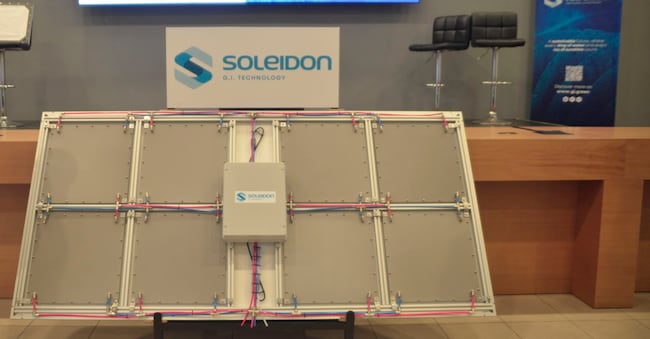
A complementary alternative to centralised infrastructure, and potentially ready in the next few years, may come from Green Independence. The Apulian start-up has devised a panel that integrates photovoltaics and desalination of seawater and waste water, and which in the future will be able to produce hydrogen off grid and on site. The start-up has already raised EUR 2.5 million from investors and public tenders and is opening a new EUR 7 million round while waiting for eligibility for EUR 5.2 million in non-repayable grants from the Integrated Facilitation Package (Pia) of the Apulia Region. Funds that will be used to build the first Soleidon panel assembly line. The goal,' explains Alessandro Monticelli, founder, CEO and CTO of Green Independence, 'is to enter the market by the end of 2026 with an already industrialised product. The demonstration pilot will be tested after the summer: the goal is to reach an annual production capacity of three hectares of Soleidon panels by 2026 and 30 by 2030'. Today, the alternative for desalinating is reverse osmosis, a process that consumes about 5 kWh per cubic metre of water. "Our technology uses the heat dissipated by the solar panel: we therefore desalinise 1 cubic metre of water while the panel produces 100 kWh of electricity: the energy balance is -5 versus +100.
But the real leap forward is the integration of a micro-electrolyser that makes it possible to use 3% of the desalinated water and all the energy produced by the panel to generate green hydrogen on site. An approach that,' Monticelli explains, 'decentralises production, cuts costs by up to a tenth compared to the current market, and shortens the supply chain, avoiding transport and compression at very high pressure. The system will be modular and, in the future, can be integrated with existing photovoltaic parks. The prototype, an addition to the Soleidon panel, is planned for the end of 2026 and the first pilot installation in 2027. Hydrogen is the energy carrier of the future, especially for heavy transport, but also for companies and energy communities. With hydrogen we free ourselves from geopolitical dependencies and rare earths, guaranteeing storage and autonomy,' Monticelli concludes.

