
Climate change, Prato's textile industry reacts and expands supply
With increasingly mild winters, companies are flanking the production of heavy woolen fabrics with lighter items. Marini (Confindustria Toscana Nord): the district has adapted to demand
3' min read
3' min read
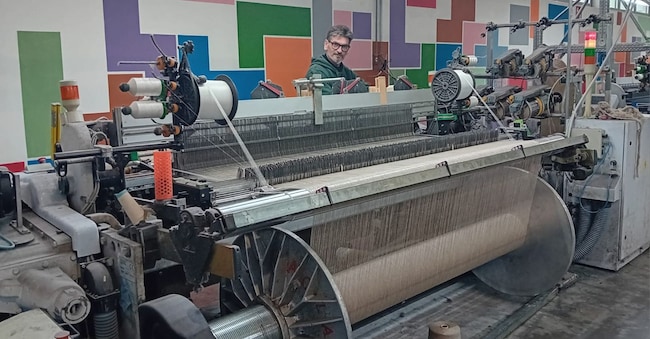
No one can deny that Prato's industrial fortune is linked to the production of carded wool fabrics for coats and jackets: cloth, velour, but also flannel are products that have made the city's history (and wealth), sold all over the world and to all the fashion brands. With climate change and rising temperatures, however, heavier fabrics risk having less appeal to consumers and thus being less sought after by the designers who create the clothes.
The phenomenon, already felt in the shops and on the catwalks, now emerges - clear and sharp - from the statistics on industrial production. Those drawn up by Confindustria Toscana Nord (Confederation of Italian Industry), which polled a sample of textile companies in the Prato district (2,400 companies, 18,000 employees, EUR 4 billion in turnover, of which EUR 1.5 billion for exports) revealed a heavy contraction in production in the third quarter (-8.3% compared to the same period in 2023, also a complicated year for the sector) with very different trends among apparently similar realities: some are performing very well and others are doing very badly.
In this difficult-to-read context, only one clear trend emerges: 'The heavier fabrics sector, probably also penalised by climate change, is the one that suffers the most,' writes the industrial association's study office. "The only clear element that emerges from the survey is the difficulty of the heavier woollen fabrics," adds Francesco Marini, president of the Fashion System section of Confindustria Toscana Nord. "Fortunately, Prato, which is hyper-specialised in woolen fabrics for harsh winters, has been able to reinvent itself over time, flanking those productions with a much wider offer in terms of fibres and heaviness.
The transition from 'heavy' to 'lighter' production, already initiated by many companies, has been accelerating recently, driven precisely by climate change, as confirmed by a historic woolen mill such as Balli, which since the post-Covid period has expanded its range to include lighter-weight fabrics, suitable for responding to mild winters and air-conditioned environments, but also to cover the spring-summer season, which until now was worth 5% of sales. "Broadening the range has been successful in resisting market jolts," explains Leonardo Raffaelli, managing director who runs the 27-million-turnover 2023 wool mill with his brother Rossano and father Enrico, "even though it is not easy, for someone who has always made a certain type of product, to make the market understand that they are also able to offer something else. We have been pushed in this direction by changes in the climate and the desire not to remain focused only on the autumn-winter collections, which have always been the most important ones in Prato'.
The transition in production does not affect everyone: 'We are specialised in wool and wool-blend fabrics, which are worth more than 60%,' explains Paolo Calabresi, owner with his brother Claudio of the Nova Fides woolen mill, 30 million aggregate turnover 2023, 'and we are not changing the weight of our articles due to climate change. Carding is still in demand, and that of lightening fabrics, or rather making them more fluid and softer, seems more a fashion trend than a real need'.

