Environment

Climate crisis, infrastructure damage in Italia of up to 5 billion a year

This is Deloitte's forecast by 2050. Within this timeframe, Italy's GDP could shrink by between 1.6 and 6 per cent. Few SMEs equipped (14%)

by Davide Madeddu

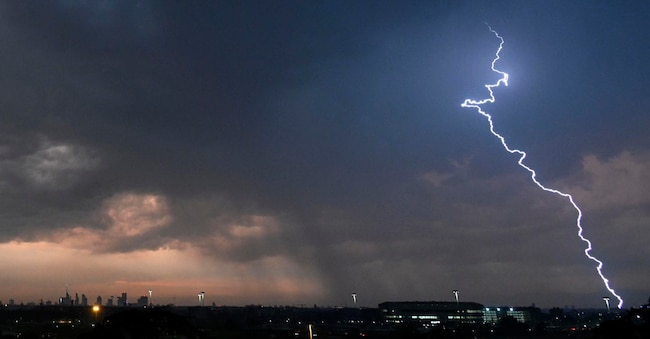
Il temporale con forti scrosci d'acqua e una breve grandinata che si è abbattuto su Milano // Lightning struck during a thunderstorm with heavy rain and a brief hailstorm that hit Milan .                                          ANSA/DANIEL DAL ZENNARO ANSA

3' min read

Translated by AI
Versione italiana

3' min read

Translated by AI
Versione italiana

The risk of climate change will be felt. And direct damage to Italian infrastructure could reach 5 billion annually by 2050. Not only that, depending on the situation there could be a progressive reduction in GDP of between 1.6% and 6% by 2050. Yet among Italian SMEs only 14% have adopted measures for business continuity in the event of extreme events and only 10% have introduced adaptation actions aimed at infrastructure and physical assets.

Outlining the framework and horizon is the Deloitte report 'Climate risk in Italia. From scenarios to proposals for action'. A study, carried out with the collaboration of experts from the Politecnico di Milano, Ca' Foscari University, the Climate area team of the Florence School of Regulation (European University Institute) and Ipsos-Doxa, which analyses the impact of climate risk on the economic-financial context in Italia and the maturity of small and medium-sized enterprises in facing the challenges.

Loading...

Risks for Italia

"Italia, due to its geographical location in the Mediterranean, is among the European countries where the effects of climate change are manifesting themselves most rapidly," says Paolo D'Aprile, sustainability leader of Deloitte Central Mediterranean, "and the main projections indicate an increase in temperatures of more than 2°C over pre-industrial levels already in the next decade. There is not only the prospect since, as D'Aprile points out, 'climate change is already producing significant economic losses that will amplify in the future'.

This is why a so-called change of pace is necessary. "In this scenario, investing in mitigation and adaptation strategies does not only mean responding to regulatory or financial constraints, but seizing a concrete opportunity to strengthen the capacity for growth and innovation of companies and territories".

The amount of damage

Over the years, the amount of damage is set to grow. The annual damage to Italian infrastructure caused by climate risk impacts could reach approximately EUR 2 billion by 2030. "Considering also the indirect effects, such as the interruption of services and impacts on supply chains," the report emphasises, "the total estimated cost is between EUR 11.5 and 18 billion per year by 2050". Also facing this situation is the tourism sector, where "demand is estimated to shrink by up to 8.9 per cent in the event of a sharp rise in average temperature (+4°C), and direct losses of around EUR 52 billion. In a scenario of a 2°C temperature increase, on the other hand, the estimated direct losses would be around EUR 17 billion'.

Depending on the scenario, the reduction in GDP could also change to 6% in 2050.

How SMEs are equipping themselves

The survey also shows that only 34% of the small and medium-sized enterprises surveyed attribute a significant or central role to the issue in their risk management frameworks and just 39% of them declare a very or fairly high exposure to physical climate risks over a ten-year horizon. At the same time, only 14 per cent of Italian SMEs have implemented measures to support business continuity in the event of extreme events, just as barely 10 per cent have introduced adaptation actions towards infrastructure and physical assets.

"On the one hand, some large Italian companies show more advanced levels of maturity with respect to the issue of sustainability and the perception of climate risk," says Elio Santoro, general manager of Deloitte Climate & Sustainability, "on the other hand, small and medium-sized companies show a still uneven path of awareness and adaptation. SMEs are called upon to make a leap forward, since the adaptation measures envisaged are not structural in nature and are mainly oriented towards the adoption of insurance coverage, in addition to planning investments that embrace a short-term time horizon'.

Then there is the investment chapter, where 'the strategy of SMEs reflects a vision oriented towards a time horizon of up to five years (83%), for a total amount of less than EUR 100,000 within three years (77%)'. The main investment items are dominated by insurance coverage (54%), followed by infrastructure adaptation (23%) and risk monitoring systems (20%). Companies that feel fully prepared to meet the demands of banks and insurance companies with regard to physical climate risk are a minority of the sample (18%). The report shows that small and medium-sized enterprises mainly rely on traditional solutions and no more than 18% of the surveyed companies use digital tools, including artificial intelligence, or platforms for physical climate risk management.

'Artificial intelligence,' D'Aprile concludes, 'is one of the main levers for maximising return on investment and increasing the climate resilience of infrastructure. For both public institutions and businesses, it is crucial to assess AI applications according to their risk exposure and to invest in digitisation, technology infrastructure, data strategies and continuous monitoring of risk analyses'.

Copyright reserved ©

Brand connect

Loading...

Newsletter

Notizie e approfondimenti sugli avvenimenti politici, economici e finanziari.

Iscriviti