
Climate: Erasmus+ students present a Manifesto for 2050 at COP31
Four key areas, eighteen themes, a shared future. Over 100 Erasmus+ students are putting forward concrete proposals to the institutions on the environment, education, employment and participation

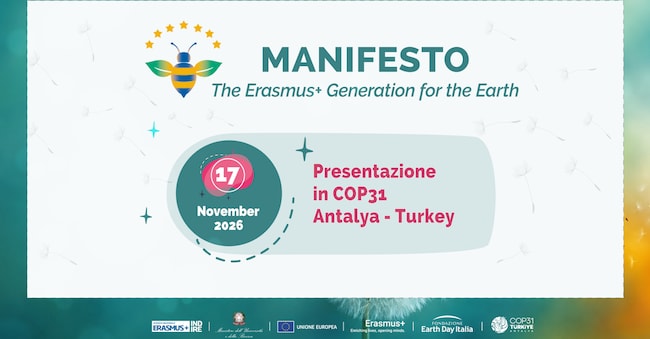
Erasmus students are presenting ‘The Erasmus+ Generation for the Earth’ at COP31 – a manifesto setting out their proposals for 2050. The document stems from a meeting organised in Rome last April by the Erasmus+ National Agency INDIRE, in collaboration with the Earth Day Italia Foundation.
There will be two events: at 9.30 am at the Italia Pavilion and at 2.10 pm at the Mediterranean Pavilion, attended by the Minister for the Environment and Energy Security, Gilberto Pichetto Fratin, to whom the students will present the Manifesto.
Il Manifesto
The Manifesto will be presented by a delegation of the 123 students from higher education institutions who worked on drafting it: a community comprising students from 20 European countries participating in the Erasmus+ Programme and from Italian universities, who gathered on 16 and 17 April 2026 at Villa Borghese.
In Rome, the students shared their experiences, expectations and concerns, discussing how to tackle the climate crisis and build a more sustainable and inclusive society. From these discussions emerged a vision for 2050 that links environmental protection to the quality of education and work, freedom of movement and democratic participation.
Key points
The key themes of the Manifesto centre on active participation, education and work, Europe’s role in the world, and building the future. Each ‘dream’ identifies changes to be made, the means to bring them about, and the outcomes to be achieved by 2050.
“The future of climate policy concerns, first and foremost, the younger generations. That is why it is important to listen to their ideas, value their skills and involve them in devising solutions,” says Gilberto Pichetto Fratio, Minister for the Environment and Energy Security. “The Manifesto presented today at COP31 is a valuable contribution: it reminds us that the ecological transition is not merely a matter of environmental targets, but also concerns education, employment, innovation and quality of life. We are committed to ensuring that young people’s aspirations can be translated into participation and concrete action.”
A space for discussion
“We have brought these students together in Rome to offer them a forum for discussion on the future they wish to build,” says Flaminio Galli, Director-General of the National Erasmus+ Agency INDIRE. “Today we are presenting the outcome of that work at COP31. Erasmus experiences enable young people to discover different realities, exchange ideas and learn to cooperate. With this Manifesto, young people are putting these skills to use in the service of a shared proposal and are calling on the institutions to listen to it.”
Climate education from early childhood
The priorities highlighted by the authors include climate education from early childhood, training programmes designed to develop critical thinking, and projects that link learning to community life. The students are calling for greener cities, circular economy systems and an accessible, integrated European rail network that makes it easier to choose sustainable modes of travel.

Brand connect


Newsletter Scuola+
La newsletter premium dedicata al mondo della scuola con approfondimenti normativi, analisi e guide operative
Abbonati