
Clooney lashes out at Trump: ‘They want us to be afraid of others, but that’s not the case’
Without mentioning the US President, the actor jokes and defends the role of journalism. The first film in the competition, *Ink*, is about the takeover of *The Sun*

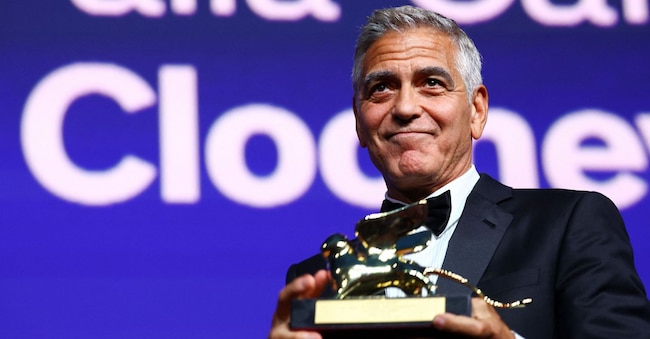
Holding the Golden Lion, George Clooney began to joke. “When they told me I’d won the Golden Lion for Lifetime Achievement, the first thing I thought was, ‘What an honour!’, and the second was, ‘They haven’t been talking to my doctors, have they?’”
The room burst into laughter, but then George Clooney – who reiterated his love for the Lido, for his wife Amal Alamuddin, his children and his circle of friends (“you don’t get to this level on your own”) – took on a more serious tone. Without ever mentioning Trump, he said, ‘We live in a time when we’re told we should be afraid of one another, but that’s not the case, and history teaches us that the people who try to silence others aren’t politicians; they’re journalists trying to ask the right questions, they’re artists, actors and musicians’. He pointed out that films do not bring down inflation, but they do bring strangers together to sit in the same cinema and to love and grieve over the stories told on the big screen.
Earlier that afternoon, Clooney had said, ‘We live in a cachistocracy – meaning a government run by the least competent – but we’ll get out of it soon.’
The opening film, ‘Ink’
The 83rd Venice Film Festival is off to a good start, at least for this writer, who has been a fan of Boyle’s work ever since Trainspotting (1996). Ink, by the British director, producer and screenwriter, brilliantly and consistently maintains – in keeping with the story it tells – the style of the ‘dancing camera’, characterised by shifts in perspective and the abrupt cuts that recur in his films and have revolutionised cinema.
The plot
In 1969, Rupert Murdoch (Guy Pearce) bought the newspaper *The Sun* from the Mirror Group, whose members were seen raising a toast, delighted to have offloaded a loss-making paper that would never have managed to recover its sales. *The Sun* had been founded by Cecil King to replace the old Labour-leaning *Daily Herald*. Murdoch, however, took a chance on a marginalised but talented journalist, Larry Lamb (Jack O’Connell), and made him editor with the aim of overtaking the *Daily Mirror* in sales. The climb to the top, which at first seems truly impossible, gradually becomes more and more realistic thanks to the recruitment of some highly talented outsider journalists, who had by then resigned themselves to being overlooked. Lamb and his editorial team embark on an adrenaline-fuelled battle – mirrored by equally frenetic direction – which propels the paper to the heights of sales through a barrage of scandals, exclusively female nude spreads and sensationalist tabloid fodder.


