The cycle traveller

“Close to home is lovely”: exploring the Lucanian Dolomites by bike

Although much younger than their ‘older sisters’ in the north, the southern routes also possess an extraordinary charm, characterised by silence, abandoned places and dreamlike landscapes. Tailor-made itineraries are available to suit your cycling holiday needs.

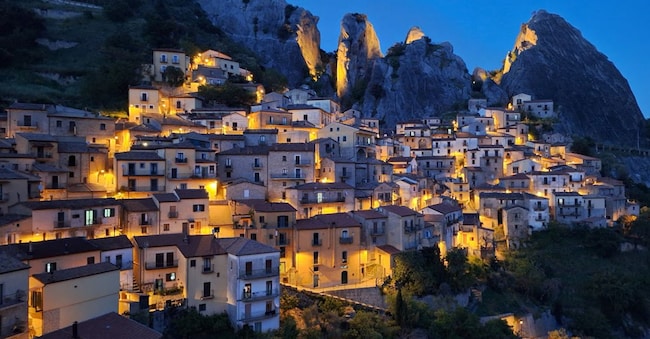
Castelmezzano al crepuscolo

6' min read

Translated by AI
Versione italiana

6' min read

Translated by AI
Versione italiana

Cycling amongst the rock formations of the Dolomites, weaving your way on your bike through the velvety green of a lush forest where the landscape is characterised not by firs and larch trees, but by downy oaks, oaks and Turkey oaks, which at these latitudes grow to altitudes exceeding one thousand metres.

No, we’re not in the Alps. We’re in the deep south, in the Piccole Dolomiti Lucane, in Basilicata – a still little-known paradise for cycle tourism.

Loading...

“Vicino è bello”: alla scoperta delle Dolomiti lucane a pedali

Photogallery23 foto

Geographically speaking, they form part of the Apennines. Like their ‘elder and more famous sisters’ in the Alps, the Lucanian Dolomites were formed on the seabed; they share the same jagged ridges and bold, bizarre, almost dreamlike shapes that intrigue visitors and leave them speechless.

However, they are much younger (“only” 13 million years old compared with 250) and considerably lower (the highest point is 1,450 metres, compared with the Marmolada’s more than 3,300 metres). Two worlds, despite the name they share, which are very different from one another.

Silence, sheep and cows

Around here, for example, you don’t hear the roar of car and motorbike engines, but the chirping of birds and the rustling of the wind through the treetops. You cycle surrounded by silence. On the winding bends of the tarmac roads, you can count the number of cars that pass by in a whole day on the fingers of one hand.

It is quite possible that you might have to give way to a herd of cows or a flock of sheep that have taken to the road, under the watchful eye of the shepherd on horseback.

In other parts of Italia, a cyclist riding on tarmac feels like an unwelcome guest, barely tolerated. Here, however, they are the undisputed master of the road. And this should come as no surprise: with 52 inhabitants per square kilometre, Basilicata is, after Valle d’Aosta, the region of Italia with the lowest population density.

Beyond Eboli

After all, we are just south of Eboli, some sixty kilometres from Aliano, the village in Lucania where, between 1935 and 1936, Carlo Levi spent two years of his life in internal exile. From Aliano – transformed in his writing into ‘Gagliano’ – Levi depicted in his novel *Christ Stopped at Eboli* the rural world of Basilicata in Fascist Italia during the 1930s. Initially, then, a place of suffering, yet so full of charm that Levi ultimately chose to be buried in Aliano itself, where he had been cast aside by the violence and oppression of a dictatorial regime.

And here, amongst ancient villages that are gradually becoming depopulated, where many young people see no future for themselves and choose to leave to settle in the cities of central and northern Italia or abroad, there is, in fact, an immense and extraordinary heritage of beauty, nature, biodiversity, resilience and human solidarity, which has only recently begun to find within itself the strength to reclaim its potential.

Steel cables for the tourism sector

Castelmezzano and Pietrapertosa are at the heart of this revival: two little gems nestled amongst the Dolomite peaks. Since 1997, the area – of immense natural beauty – has formed part of the Gallipoli Cognato and Piccole Dolomiti Lucane Regional Park. Ten years later, in 2007, the two villages were linked by an aerial cableway. They call it ‘the Angel’s Flight’, a system of steel cables suspended in mid-air for about one and a half kilometres.

Loading...

Anyone looking for an adrenaline-fuelled experience can be launched in either direction, reaching speeds of over 100 kilometres per hour at a height of up to 400 metres above the ground, before finding themselves on the other side of the gorge.

Strange as it may seem, the rise in tourism in these previously neglected villages did not stem from their scenic and natural treasures, which in themselves could have been their ticket to success. Instead, it began almost twenty years ago with the steel cables of the ‘Volo dell’Angelo’, which quickly established itself as a successful tourist attraction, drawing the attention of the media and the public on a national scale.

Then came the ‘slittovia’ in Castelmezzano – a descent through the rocks on a monorail – which also attracted many fans. And then the via ferratas. And the treks. Within a few years, the derelict cottages in these two villages had been converted into bed and breakfasts or small, scattered hotels.

The photograph of Castelmezzano against the backdrop of the Dolomite peaks has become an iconic image of Basilicata, which is promoting itself to the world as a tourist destination. In no time at all, the village has become a highly sought-after spot for selfies to be shared instantly on social media.

And yet both villages, however much they have been transformed by tourism, are still very beautiful today. They are well worth a visit. But this is a process that needs to be managed carefully, because the line between neglect and the negative effects of overtourism can be very fine.

It’s lovely to be close by

“There is no doubt that the ‘Flight of the Angel’ has brought glamour to this area and breathed new life into the villages,” observes Marco Delorenzo, director of the Regional Park. “We are trying,” he adds, “to strike a balance between protecting our natural and landscape heritage on the one hand, and promoting tourism on the other. If nature-based tourism takes off, everyone stands to gain, including nature itself.”

This is another reason why the Park has created a ‘Ciclovia della Bellezza’ (Cycle Route of Beauty). The name could not be more apt. It is a 72-kilometre loop along tarmac and dirt tracks through the woods. It’s a marvel.

“All too often,” Delorenzo remarks, “we forget that ‘close to home is lovely’. Sometimes we take planes, travel thousands of kilometres and produce CO₂, just to reach faraway places and see things that are right on our doorstep, where you least expect them.”

But for cycle tourists looking for something more than just the “Ciclovia della Bellezza” loop, Basilicata has a great deal to offer. There are few proper cycle paths. However, this lack of infrastructure can easily be overcome by choosing to cycle along the tarmac roads of the secondary road network, which effectively serve as cycle routes.

Hiking apps such as Komoot, Ride with GPS and others can help with this. Alternatively, you can get in touch with one of the bike travel designers operating in the area.

Among them is Simon Laurenzana, aged 46, who has a background as an educator and a present and future as an operator and entrepreneur in the field of cycle tourism. He is one of those who have chosen to stay in their home region and to focus on cycling as a driver of development in order to make a living from it.

Year on year, his brainchild, the Basilicata Bike Trail, is becoming increasingly popular. It is a non-competitive event for lovers of cycle touring in the form of bike packing. In 2026, for the sixth edition, three hundred people from all over Italia signed up. These are significant figures for Basilicata, unprecedented in the region. The re-registration rate stands at 25 per cent, a sign that the event is popular. The model, which has already been tried and tested in other regions (Tuscany Trail, Marche Trail, Veneto Trail), is proving successful.

The route is a ‘coast-to-coast’ journey from Metaponto on the Ionian Sea to Maratea on the Tyrrhenian Sea. There are three different routes, varying in difficulty to suit all tastes. “The participants,” notes Simon, “are a mixed bunch: from the ultracyclist who cycles even at night to the couple on their first cycle tour.”

Bespoke itineraries

Through his business, Bike Travel Basilicata, Simon creates bespoke GPX tracks on request, tailored to the client’s specifications. He takes note of the client’s requirements: number of days; maximum distance per stage; elevation gain; tarmac or dirt tracks; gravel, mountain bike or road bike; places to visit. The result is a personalised itinerary that visiting cycle tourists can follow using their bike sat-nav.

The cycle tour described in this story came about in this way, from his pencil. “Basilicata,” says Simon, “is a little-known destination. I’ve been cycling through the nooks and crannies of this region for years. But even today, I’m still surprised and thrilled by it. Cycling around here is a real treat.”

Vincenzo Grippo, the park’s president, is on the same wavelength. “Our area,” he says, “is an extraordinary treasure trove of biodiversity. It is an open-air scientific laboratory which, thanks to its richness and variety, enchants everyone, from experts to children.”

And how can you blame these people from Basilicata who are so in love with their homeland? Indeed, after cycling through the Little Dolomites, even the most demanding and seasoned cycle tourist has to admit that, deep down, it really is true: “Close to home is beautiful”.

Copyright reserved ©
Loading...

Brand connect

Loading...

Newsletter

Notizie e approfondimenti sugli avvenimenti politici, economici e finanziari.

Iscriviti

Tutto mercato WEB