
Coast Guard 'digital guardian' of the sea: data exchange for defence and security launched
Today the first coordination meeting between the administrations. General Commander Nicola Carlone: 'We aim for simpler and more efficient services'
3' min read
Key points
3' min read
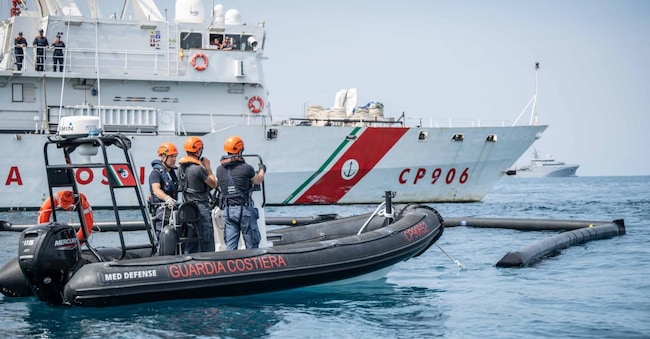
The role of 'digital guardian of the sea' of the Coast Guard General Command, the national authority responsible for managing the Vessel Traffic Monitoring Information System (Vtmis), comes into its own. Now called to the task of exchanging data and information with all administrations involved in defence, security and public rescue through state-of-the-art technological solutions.
The first summit between administrations
.Today the first coordination meeting was held between the various bodies involved in the Decree of 11 March 2025, with which Italy, in implementation of Directive 2002/59/EC (implemented by Legislative Decree 196/2005), regulated the establishment of the Community vessel traffic monitoring and information system. The aim: to increase the safety and efficiency of navigation, the safeguard of human life at sea, and the protection of the marine and coastal environment through an increasingly dense exchange of information and data. Present at the table with the Coast Guard were the Ministry of the Interior - Border Police, the Ministry of Defence, the Guardia di Finanza, the Customs Agency, Istat and Federagenti.
The technical modalities for data exchange have been defined
.Article 9 of the Legislative Decree had stipulated that the General Command of the Harbour Offices - Coast Guard should make available to the bodies in charge of national defence, maritime surveillance, public safety, civil defence and public rescue, data on naval traffic, when they were relevant to the different subjects, according to technical modalities set out in special interministerial decrees. The March decree finally took on the task of defining them, stipulating that the interconnection and interoperability between Vtmis and the systems at the disposal of the bodies in charge must guarantee a digital exchange of data, to be achieved through cooperation agreements between the administrations concerned. The start of technical-operational coordination between the entities involved therefore aims to define common standards, interoperability protocols and data traceability with a view to security and simplification.
Interoperability according to the best technological solutions
.Interoperability will have to be adapted to the best technological solutions, in line with Agid circulars and with the criteria imposed in some areas by other European standards, such as Regulation 2019/1239 that established the European Maritime Single Window environment, a European evolution of the Port Management Information System that today manages all the information that must be exchanged on the arrival, stopover and departure of ships from national ports and included in the Vtmis platform.
Read more about the platform for arrivals and departures
.In order to adhere to the European Regulation 2019/1239, the General Command of the Harbour Offices - Coast Guard, identified as the national competent authority Emswe, has re-engineered its Port Management Information System platform and initiated with the administrations involved in ship arrival and departure formalities permanent tables and a National Coordination Committee to enable the technological solutions adopted to meet European requirements while maintaining the efficiency of information flows.


