
Coface revises its global growth forecast downwards, downgrades eight countries and 41 sectors
The global impact of the conflict in the Middle East is being felt. According to Coface’s CFO, the consequences for trade flows and corporate profitability will continue to be felt in the coming months

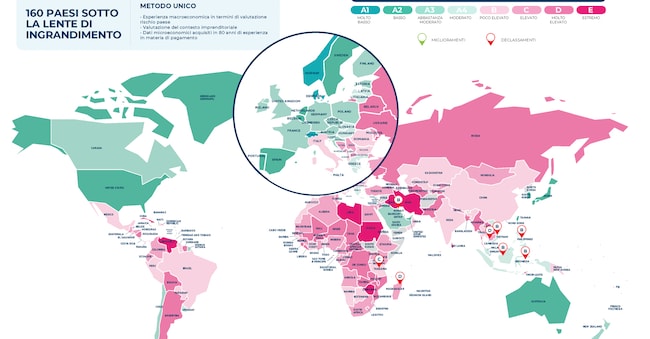
(Il Sole 24 Ore Radiocor) - The economic shock caused by the conflict in the Middle East – from supply chain disruptions to the resurgence of inflationary pressures – is already having an impact on the global economy. Against this backdrop, Coface, one of the world’s leading providers of credit insurance and commercial risk management, has revised downwards its global economic growth forecasts and the ratings of eight countries, as well as amending 45 sector ratings, with 41 downgrades compared with just four upgrades. This is the picture that emerges from the new “Coface Risk Review” report published in June 2026.
“The ceasefire in the Middle East is welcome news, but it cannot obscure the key issue: the disruptions already underway will continue to weigh on business activity, incomes and employment,” explains Jean-Christophe Caffet, chief economist at Coface. “The unprecedented number of 41 sector downgrades across 19 countries highlights the global impact of a conflict whose consequences for trade flows and corporate profitability will continue to be felt in the coming months.” Among the sectors downgraded are the automotive and construction sectors (in the United Arab Emirates only), the energy sector (in the Netherlands, Saudi Arabia, the UAE and South Korea), and the agri-food sector (Australia, the Czech Republic, Mexico and India). Sector downgrades also include lthe Italian paper industry and those of other major European countries (France, Germany, Spain and the United Kingdom). Among the upgrades is the energy sector in the United States and Canada. The eight countries that have been downgraded are: Cambodia, Indonesia, Kuwait, Madagascar, Malaysia, the Philippines, Tanzania and Vietnam
The global economy is holding up, but slowing down
“So far, the global economy has absorbed the shock, partly thanks to the pre-emptive build-up of stocks and adjustments in demand,” explains the report. “This phase, however, is reaching its limits. Production disruptions in certain sectors, the return of inflationary pressures and the tightening of financial conditions are the first signs of the difficulties currently unfolding, whilst governments have limited room for manoeuvre to support economic activity and incomes.” Against this backdrop, Coface is revising its growth forecasts downwards: +2.3% in 2026 and +2.5% in 2027, representing an overall reduction of 0.6 percentage points over two years. The de facto closure of the Strait of Hormuz – 145 ships passed through in May, compared with over 3,300 a year earlier – has disrupted global transport and put supply chains under pressure once again. Businesses are already reporting longer delivery times, rising costs and early signs of shortages, prompting them to build up precautionary stock, with a consequent impact on liquidity and margins. Against this backdrop, corporate insolvencies are expected to continue rising throughout the year, with a projected 6 per cent increase globally and particularly sharp rises in certain countries, including the United States, France and Japan.
“The slowdown in the global economy and the resurgence of inflationary pressures confirm just how quickly geopolitical tensions can affect international trade and the financial health of businesses,” comments Ernesto De Martinis, CEO of Coface’s Mediterranean & Africa Region and Board Member. “In a context where supply chains remain under pressure and corporate margins are increasingly squeezed, it is essential for companies to closely monitor the reliability of their trading partners, cost trends and the resilience of demand in the markets in which they operate”.
Modest growth for the eurozone; inflation rises again in the US
The shock is global in scope, but its intensity varies significantly from region to region. In the Middle East, the Gulf States are the most exposed, with significant contractions linked to their heavy reliance on the Strait. In Europe, rising energy prices and ongoing uncertainty are weighing on domestic demand: growth in the euro area is expected to be limited to 0.7 per cent. In the United States, inflation has risen again, climbing from 2.4 per cent in February to 4.2 per cent in May, affecting the purchasing power and consumption of low-income households. In Asia, the picture is more mixed: some sectors continue to hold up well, as demonstrated by the 153 per cent increase in South Korean semiconductor exports since the start of the year, whilst other sectors are having to contend with increasingly squeezed margins. In emerging economies, particularly in Latin America, the shock has led to a resurgence in inflation and more restrictive monetary policies. This is the case in Brazil, where the base rate stands at 14.5 per cent.


