
Cohesion and investment: the EU route to curb China and the US
Bassanini: 'More qualified majority decisions and common debt'. Tria: 'Today's choices are driven not by the market but by geopolitics'

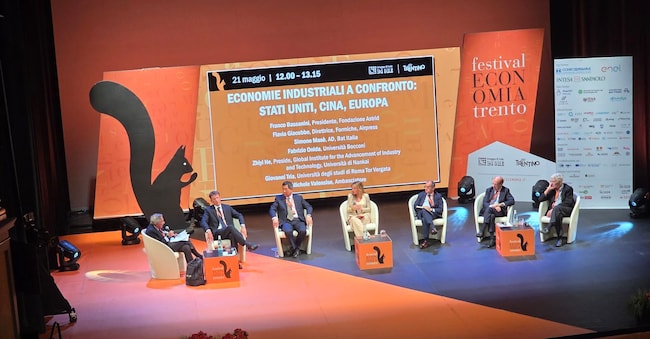
No middle ground between war and peace? No, Cicero was wrong,' explains Ambassador Michele Valensise, and what is happening between the United States, China and Europe demonstrates this plastically. Of course, in the days of the great Roman orator, relations between states were much simpler and clearer, or black and white. Whereas today the confrontation between the great powers is also made up of nuances, somewhere between strategic rivalry and interdependence.
Comparing the three areas, the objective of the debate between economists at the Trento Festival of Economics, means first of all taking note of an epochal change that has occurred as a result of the new wave of protectionism. "If in the past, with globalisation, it was the market, i.e. companies, that guided the localisation of plants and technologies," argues Giovanni Tria, "now we act according to geopolitical principles, interventions by states not directed to collective goods, such as the environment, but to protect national priorities".
In which each deploys its own strategies. China has a strong savings rate of 40% and a talent-training plan launched in the 1990s (the aim being to create 100 world-class universities); the USA, on the other hand, although it does not create its own savings, manages to attract them thanks to the dollar and technological innovation, two powerful magnets for investment. And then Europe, which lies somewhere in between.
Europe still has cards to play, however,' explains Valensise, 'if it acts with awareness of its capabilities, finding cohesion and courage. Focusing on technological innovation and the expansion of trade agreements, but also wielding - if necessary to defend itself against Trump - the weapon of anti-coercion instruments.
A Europe - argues the president of Astrid Franco Bassanini - that has a chance to catch up only by following the guidelines outlined by Draghi. Exploiting also the double 'assist' , certainly unintentional in this sense, provided by Putin and Trump. 'The scenario has changed,' he explains, 'and public opinion today feels threatened and strongly demands more Europe, also with more resources. Even the sovereignist parties in the various countries will have to take note of this sooner or later: the prime minister Giorgia Meloni has done so, not Salvini yet'.


