
Collectors’ cars are increasingly worth millions
From stagnation to a record $3.5 billion (+62 per cent): Ferrari leads the way. Historica Selecta’s ‘Classic Car Auction Yearbook 2025–26’ was presented at the Auto e Moto d’Epoca motor show in Bologna

Key points
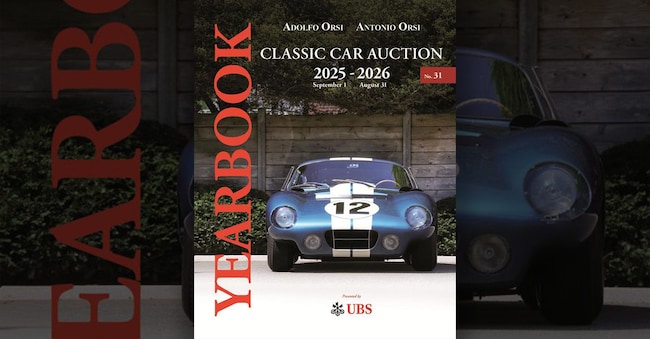
The Auto e Moto d’Epoca motor show in Bologna (22–25 October) provides the setting for the annual presentation of the report on the classic car market, attended by executives from leading international auction houses. The ‘Classic Car Auction Yearbook 2025–26’ by Historica Selecta, compiled by Adolfo and Antonio Orsi based on nearly 12,000 annual auction results – which are added to a database containing over 150,000 historical values – highlights a dramatic shift in the market, from the stagnation of the two years following the pandemic to the new records set this summer in Monterey, California. The record total value of $3.5 billion – achieved through the sale of 9,000 cars out of 11,800 lots – represents a 62 per cent increase on the previous year, following three years of stability at between $2 billion and $2.2 billion.
The US millionaire market
The market’s growth is largely attributable to the segment of cars valued at over a million, which has almost doubled: 536 lots alone account for 53 per cent of the total value, whilst the 7,660 cars below the $200,000 threshold account for 16 per cent, the same as the 28 that exceed the $10 million threshold. Unsurprisingly, this sector of the collecting world, which is increasingly reliant on a handful of multimillionaires, is taking on the ‘K-shaped’ form of the US economy that drives it: prices for million-dollar cars have skyrocketed, whilst the rest of the market remains stable.
The sales figures speak for themselves: three-quarters of sales take place in the United States, partly thanks to the rise of online auctions, which account for as much as 43 per cent of lots but only 27 per cent of the value. The now irreversible collapse of the UK market, reduced to 3.4 per cent (from 17 per cent pre-Brexit), is only partly offset by growth in France (6.5 per cent) and Monaco (3.1 per cent), thanks, respectively, to the auctions linked to the Retromobile fair in February and the biennial Grand Prix Historique in May.
Ferrari and the others
Growth is concentrated on a small number of makes and models. Ferrari dominates the field, accounting for 35 per cent of the market – a jump of over 10 percentage points in a year – thanks to six ‘limited edition’ models sought after by collectors who have more money than imagination: the 288GTO, F40, F50, Enzo, LaFerrari and SP3 ‘Daytona’, which now command a combined total of over 60 million dollars, following the records set by the Bachmann collection in January. The rise is staggering: the Enzo has gone from $4 million to over $11 million in two years, whilst the F50 has risen from $4.9 million to $7.3 million, eventually reaching $10.3 million. The average value of the 1,745 Prancing Horse cars offered (470 more than in 2024–25) stands at just under one million dollars, exceeding the global average of 400,000 dollars, with 64 cars featuring in the top 100 sales.
But it is three exclusive manufacturers that achieve average sales figures in the millions: Gordon Murray with the successor to the McLaren F1, Pagani (eight cars sold out of 11, averaging $5 million) and Bugatti, with an average value of $2.6 million across 36 cars from the 1930s to the present day. These results are due to the genuine rarity of the small number of cars produced, rather than the artificially induced rarity resulting from the ‘limited editions’ typical of Ferrari and Porsche.

