Latin America

Colombia on the ballot between fear, hope and drug trafficking

Presidential elections: Right and left challenge each other on security and economic revival

by Roberto Da Rin

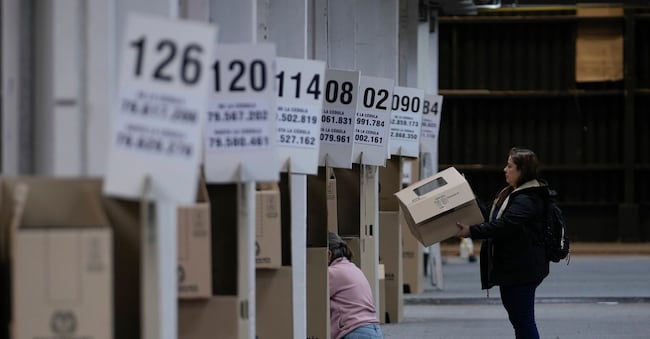
Venerdì 29 maggio 2026, a Bogotà, in Colombia, gli addetti alle operazioni elettorali allestiscono un seggio in vista delle elezioni presidenziali di domenica. (AP Photo/Matias Delacroix)

4' min read

Translated by AI
Versione italiana

Key points

  • There are three favoured candidates: Cepeda (left), de la Espriella (right), Valencia(centre)
  • Themes: security policy, economic growth and the perennial nightmare of drugs
  • The Trump variable

4' min read

Translated by AI
Versione italiana

Disregarded peace agreements, an economy poised between recovery and recession, the eternal scourge of drug trafficking. But also extraordinary potential for development, a strategic geographical position defined by a bi-oceanic outlook, several universities of international prestige.

Colombia's presidential elections revolve around major national (growth and security), international (trade agreements) and supranational (drug trafficking) policy issues. The outgoing president Gustavo Petro, a progressive, had to defend himself, only a few weeks ago, against an odious verbal attack mode, that of Donald Trump: 'the president of Colombia has to watch his backside...'. There are three strong candidates: Ivan Cepeda, 63, from the left, heir of Petro, Abelardo de la Espriella, 47, from the extreme right,Paloma Valencia, 48, from the centre-right. A few days ago they closed their campaign with large public demonstrations: in Barranquilla, Medellin and Bogotá in an attempt to win over the last undecided voters before the vote that will designate President Gustavo Petro's successor.

Loading...

Polls

Polls confirm left-wing Senator Cepeda in the lead (45% support, according to CNN), followed by right-wing Trumpian lawyer de la Espriella (37%), while conservative Democratic Centre candidate Paloma Valencia (33%) is aiming to enter the runoff scheduled for 21 June.

Cepeda, candidate of Pacto Historico and supported by the progressive area close to Petro, relaunched social issues to protect the weakest: 'Our government will be a government of social justice and equity,' said the senator, promising to put 'the State at the service of the excluded'. In his speech he also called de la Espriella 'a fascist option'.
De la Espriella staged the final event of the campaign in Medellin's La Macarena arena, surrounded by armed forces veterans and supporters of the radical right, behind an armoured screen. "It has been a tough campaign full of attacks, now we only have one place left to conquer: the ballot box".
In Bogotá, Paloma Valencia closed the electoral race by promising 'a secure, fair Colombia with opportunities for all'.

Colombia al voto, sinistra e destra si sfidano sulla sicurezza

Attention is focused on de la Espriella, polls give him a strong recovery. Self-described El Tigre, wearing a bulletproof vest, jumping behind bulletproof glass, he revives his motto: 'Firme por la patria' (fiero/strong for the fatherland).

The legacy of the first left-wing government

Beyond the slogans, the first left-wing government in the history of Colombia, led by Gustavo Petro, leaves behind, after four years in office, an economy with positive signs on the social level but shadows on the macro-financial level.

The unemployment rate is the lowest in the century (8.8%) and poverty is falling (31.9%). Tourism has grown and some agricultural sectors have boomed. These achievements coexist with a fiscal threat and low investment that could jeopardise the future. Uncontrolled public spending, high-interest debt and unstable tax revenues have put a strain on state coffers. According to the United Nations, Colombia already has the second worst public deficit as a percentage of GDP in Latin America (6.4 per cent), a public debt of 58 per cent.

Whoever wins the elections will find a very different Colombia from the one of 2022, where completely different visions on how best to improve the economy, public finances, security and close inequalities will coexist,' says Víctor Aguilar, Crisis Group analyst for Latin America. "The next government must show great political skill in reaching agreements if it is to maintain governability, knowing that a large segment of the population does not share its vision."

The big issues: drug trafficking, violence, security, macroeconomic stabilisation

Violence marked this election campaign even before it began. In June 2025, presidential candidate Miguel Uribe Turbay was shot in broad daylight during a rally in Bogotá and died shortly afterwards. All three main candidates reported receiving death threats. And the Electoral Observation Mission (MOE), an organisation monitoring the elections, has warned that 386 municipalities - just over a third of the country - are at risk of political violence by 31 May.

Widespread crime in the capital cities is a cause for concern, but above all, the territorial control exercised by armed groups that, in the last decade, have occupied the spaces left vacant by the FARC after the Peace Accord is alarming. In the first five months of 2026, Colombia recorded 54 massacres and 233 deaths, while the ranks of drug traffickers, guerrilla and paramilitary groups, in many cases composed of minors, are growing. Epochal challenges.

To think that the history of Colombia is full of wonderful suggestions. A country with a great literary tradition where the entire supply chain (paper, raw material for books, publishers and authors) was cultural oxygen during the long years of the obscurantist Spain of General and dictator Francisco Franco (1892-1975).

And before that, stabilising the country was not just the vote, but a credible power-sharing mechanism: the so-called 'incomplete vote' of 1905, which guaranteed the minority a third of the seats. There followed almost half a century without a national civil war. Then even that balance wore off.

Copyright reserved ©
Loading...

Brand connect

Loading...

Newsletter

Notizie e approfondimenti sugli avvenimenti politici, economici e finanziari.

Iscriviti