
Comet C/2025 A6 Lemmon: A guide to its observation with the naked eye
Discovered at Mount Lemmon Observatory, comet C/2025 A6 Lemmon will be visible to the naked eye at the end of October. Find out how to observe it in the sky.

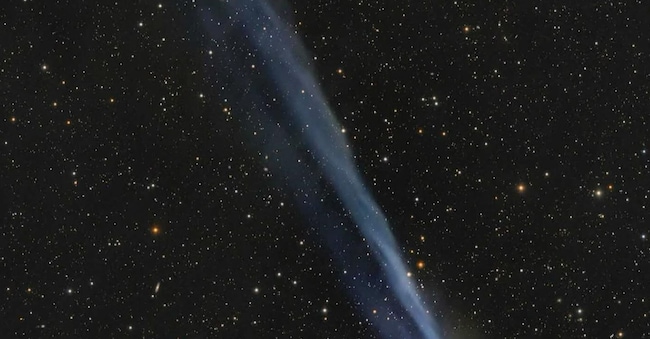
October, which starts today, gives us a comet, C/2025 A6 Lemmon. It is already visible, with good binoculars or a small telescope, but through the end of the month and into early November it will probably be visible to the naked eye in the sky. The conditional is a must because comets often cause surprises.
It was discovered at the beginning of the year, by an astronomical observatory specialising in the search for small bodies in the solar system, asteroids and, indeed, comets, that of Mount Lemmon, in Arizona, USA. It is famous for the large number of small planets discovered, solid bodies a few hundred metres or a few kilometres in size, and comets.
Our comet is not a recurring comet, i.e. it is bound to the sun in an orbit that will make it return, in a certain number of years, be it 10 or 1000, so one must hope to enjoy the opportunity this time, because there will be no more until the end of time: who knows where C/2025 A6 will go when it leaves the solar system.
Now, however, it is approaching the Sun and at the end of the month it will be at the closest point to our mother star, which it can reach. For this reason, the sun's action will be at its greatest and will hit the nucleus of the small comet with the solar wind, made up of elementary particles and radiation that it continuously emits. Incidentally, the earth's atmosphere acts as a shield and filter for us and the solar wind, which could do us much harm, can only contribute, when it is particularly strong, to the formation of the aurora borealis, or southern lights.
The combination of particles and radiation impacts and heats up the core of the comet, which is generally composed of rocks, dust and ice: the surface then releases microscopic grains of dust and ice that form, like millions of tiny reflecting sunlight, the beautiful tail, which is the spectacular yet ephemeral part of this transient phenomenon. However, in some cases the tail itself can reach very considerable lengths: from a few million kilometres up to even 150, like the distance from the Earth to the Moon.


