
Commercial and industrial vehicle market in Italy and the EU down, worse than cars
Anfia: In the first nine months of the year -6.1% of vans in Italy, -8.5% in Europe - On 17 December the click day for companies scrapping polluting vehicles

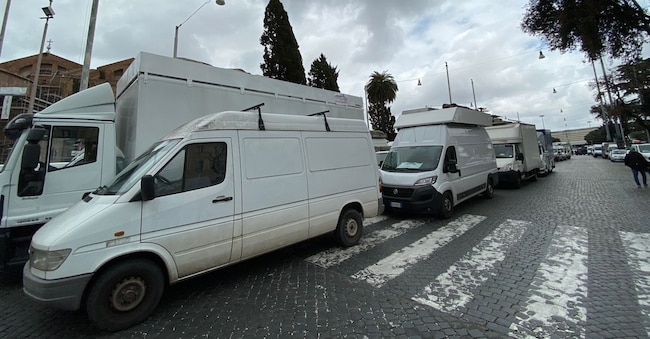
The market for light commercial vehicles and trucks is suffering. The results for the first nine months of the year are compiled by Anfia. The light commercial vehicle market closed the first nine months of 2025 with over 141,000 vehicles registered, -6.1% compared to the same period in 2024, when volumes already exceeded 150,000 units. The heavy truck market had 20,823 registrations, down 8% compared to 2024. The only exception is the market for towed vehicles with a total payload of more than 3,500 kg, which had closed 2024 in the negative with a -13.2% drop in registrations compared to 2023 and which, on the other hand, will grow in 2025.
If one compares the situation of the Italian market with the European market, the situation is even worse. In the first nine months of 2025, the market for light commercial vehicles in the EU, Efta and the UK stood at around 1.36 million units, a drop of 8.5% compared to the same period in 2024. Looking at volumes of trucks with a gross vehicle weight of more than 3,500 kg, there are just under 269,000 new registrations, down 9.9%. Analysing the truck market by segment, heavy trucks (ptt ≥16,000 kg) recorded a decrease of 9.5%, with almost 219 thousand units sold.
This is a key market segment both for its industrial impact - Italy produces light commercial vehicles for Stellantis as well as the Daily for Iveco, among others - and for the sector's impact on the decarbonisation of transport in general. In order to speed up the process of renewing the circulating fleet, the Ministry of Transport has earmarked 590 million funds for transport companies wishing to invest in vehicles with a lower environmental impact, a measure that covers the period 2027-2031, thus a real multi-year plan that has been welcomed by the sector's associations.
Next 17 December, on the other hand, there will be a click day to apply for the funds provided by Decree no. 203 of 7 August 202, which makes available a total of 13 million euro, intended precisely to encourage the renewal of vehicle fleets by eliminating the oldest vehicles and encouraging the purchase of more sustainable and technologically advanced solutions. The application window lasts until 16 January 2026. Contributions range from 4,000 to 24,000 euros, with an additional bonus of 1,000 euros if an obsolete vehicle is scrapped, and include: Hybrid diesel/electric, Full electric, CNG and LNG (liquefied natural gas). The purchase of Euro 6 diesel vehicles is only permitted with the scrapping of vehicles of 7 tonnes or more, and contributions from 7 to 15 thousand euros.
If the scrapped vehicle is Euro IV or lower, the application has priority and an extra bonus of 5 to 10 thousand euros is granted. As far as light commercial vehicles (3.5 t - 7 t) are concerned, the purchase of a Euro 6 step E / Euro 6 E is only allowed with scrapping and a basic contribution of 3 thousand euros. The measure covers all vehicles purchased from 21 October 2025 onwards. Each company may also submit only one application per period, including several types of investment, up to a total maximum of 550,000 euros.


