
Contractors at the centre of the Logistic Village: from contracts to new regulations
At the Fiap space at Transpotec Logitec focus on the relationship between supply and demand for logistics services
by Andrea Fontana
 Aggiungi Il Sole 24 Ore
ai preferiti su Google
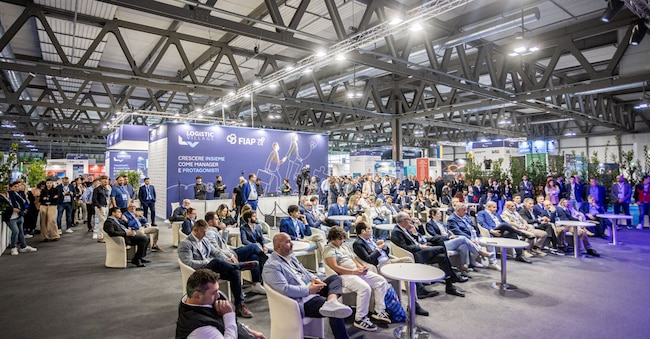
A closer relationship between principals and logistics service providers is the answer with which manufacturing companies try to meet the challenges of competitiveness that are called delivery times, cost containment, and flexibility to external geopolitical shocks. According to the Contract Logistics Observatory of the School of Management of the Politecnico di Milano, the centrality of this collaboration is also evident in the contracts between the parties: in 59% of the cases, structured continuous improvement practices are now put down on paper, not only to optimise costs but also to verify and increase the level of service, share best practices and information on future forecasts of transport volumes. In 2017, only 25 per cent of contracts included such items.
The need for periodic comparison
"The number of cases in which continuous improvement practices are formalised in contracts is increasing," explains Paolo Giacobbe, researcher at the Contract Logistics Observatory, "and this is very important because in the face of rising costs and increasing variables, which are already reflected in the various forms of indexation of contracts, the two parties recognise the need to have periodic comparisons on longer-term projects on processes, efficiency, innovation and in some cases technology. An exchange that, on the one hand, makes the haulier and the logistics operator proactive and, on the other hand, requires the ordering company to be better acquainted with the rules, risks and potential of logistics.
At the Fiap Logistic Village the focus is on customers
The focus on customers is the approach that the Fiap Logistic Village, the space within the Transpotec Logitec 2026 exhibition at Fiera Milano, will take to discuss the future, regulations and problems of logistics, starting from the demand that ends up guiding the choices of the supply chain. In the foreground the driving sectors of Italia's exports, which in 2025 still grew by 3.3%, such as pharmaceuticals (+28.3%) and food (+6.3%) but also fashion.
In foreign sales, one knot is that of Ex Works clauses, used by more than half of exporters - 58% in 2019-25 according to Contship&SRM's Logistics Corridors Report - in which the seller transfers all the costs and risks of the transport operation to the buyer. A formula, experts say, that puts Italian suppliers in a weak position when negotiating against large foreign groups that use their own country's or international logistics services and limits the development of Italian logistics operators. However, ceding control of distribution, Fiap warns, also exposes manufacturers to a risk, namely that of ceding control of the end customer.
Regulatory risk: variables to quantify
New regulations and potential visible or hidden costs are another chapter in the Logistic Village to start quantifying their impacts, economic and otherwise, for contracting companies. From decree-law 73 of 2025 on payment times in road haulage contracts to the exemption for loading and unloading waits, to the National Electronic Waste Tracking Register, there are several regulations that have recently been amended and those that are about to come into force such as Ets2, the pollutant emission trading mechanism that will also affect road transport in the coming years. The invisible costs, in terms of loss of competitiveness, for example, are those that have to do with infrastructure nodes, starting with the blockades at the Alpine passes, on which important responses are expected in the summer with regard to the Brenner and Mont Blanc routes.
Employment needs: numbers and figures
There is also a large chapter concerning the skills and employment needs of the mobility and logistics supply chain: the latest forecast made by Unioncamere's Excelsior information system quantifies this at over 150,000 employees in the 2025-29 period, in the event of a positive economic scenario (almost 139,000 in a negative one), of which 138,000 for the necessary generational change and 13,000 for the increase in demand. Figures to be found and trained. The mobility and logistics supply chain, says the report, "will need professionals capable of adapting to the rapid evolutions of the sector, given the digital transformation of logistics operations: from the analysis of online ads in Italia and Germany, we will see, on the one hand, a convergence of analytical, technological and management skills in logistics professions (such as supply chain/logistics manager, operations supervisor) and, on the other, a growth in demand for ICT specialists such as web developers and mobile applications developers".

