
Companies and schools open up to jewellery talent
During 2023, according to Federorafi, employment in the sector will grow by almost a thousand. But that is not enough: within five years thousands of new professionals will be required to cope with the outflow and demands of international companies

3' min read
3' min read
In March 2023, Federorafi had launched an alarm in the pages of Il Sole 24 Ore regarding the low turnover of professionals, estimating that, within five years, the sector would need around three thousand new young people to join the industry, equal to around 10% of the total workforce, to replace retirees and those about to retire. Over the past year, something has changed: against a background of a general slowdown in luxury, which suggests a slowdown in production, employment in the sector has increased by 936 in the year 2023. A year that, for Italian jewellery companies, has nevertheless gone well: the industry recorded revenues of just under 12 billion euro, up 10.2 per cent.
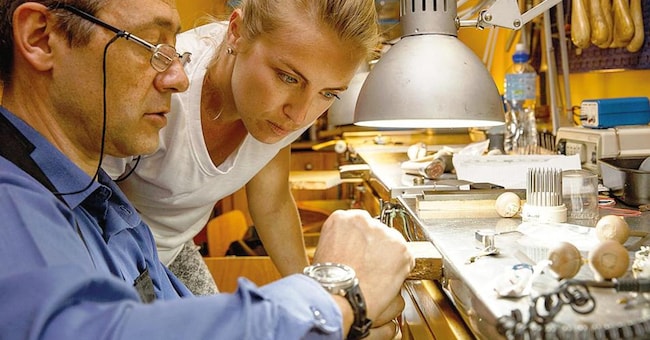
The search for talent by companies, therefore, is certainly not on stand-by. Nor is it simple: the goldsmiths who will work in the sector will have to respond to a twofold need of companies: on the one hand, to have high-level professionals capable of learning complex traditional techniques - such as Van Cleef&Arpels' Serti Mystérieux, even patented in the 1930s (see the piece opposite) - guaranteeing continuity, and on the other hand, to be perfectly integrated in a world in which technology is not only a fundamental component of the goldsmith industry, even though it remains de facto artisanal, but is evolving very rapidly.
The demand for professionals who know how to work along this double track is often referred to schools that provide highly specialised training. The real turning point came with the big brands and investment funds,' says Luca Solari, director of the Scuola Orafa Ambrosiana, founded in 1995 and now present in Milan with three branches, 'because their great economic availability allowed the brands to grow by opening new sales outlets all over the world. Hence the need to increase production by looking for new specialised artisans'. Soa, which has recently opened a laboratory where the most 'innovative' training is experimented, works in partnership with companies: 'We offer a tailor-made training service by bringing their DNA into the school through teachers who come directly from the brands. An example is the project with Buccellati". With the Florentine maison, in fact, Soa has designed (and then launched) the first master's degree dedicated to 12 students with 10 courses - including three master classes: microscope setting; engraving; embossing and chiselling - and 90 hours of practice. According to Solari, the evolution of schools and, in general, of the training of goldsmiths has made this profession more attractive, changing the pool of enrolled students: "There are many young people, including foreigners, and they are the first to bring to their daily work the interest in innovation and also that in sustainability, which for the younger generations is a way of life".
The Goldsmiths' Academy in Rome, founded in 1983, also has an important share (30-40%) of students arriving from abroad. Neophytes or professionals in search of highly specialised and innovative training: "Our courses are designed to train from scratch professionals who will be able to work in all the major jewellery companies," explains Alessandro Gerardi, co-director of the Academy, "but also for upskilling experienced professionals. The combination of tradition and innovation is a pillar of the training offer: "We have recently inaugurated a setting school, the Gerardi Setting School, where we use an innovative method employing the latest available technologies. There is more and more competition in the sector, and to beat it, you have to aim for excellence'.
The companies themselves have got directly involved in training by opening their own in-house academies. There are many examples: in Valenza Po, both the Damiani Academy and the Bulgari Academy are training their employees, and Bulgari is also opening one, focused on high jewellery, in Rome. Precisely on the occasion of the presentation of the restoration project of the Vittoriano statues last February, Jean Christophe Babin, CEO of the Bulgari maison, declared that for this profession "there are schools, but it is clear that they are insufficient to provide the skilled labour that this industry requires". So it is not surprising that from Cartier (in Turin, where the new factory has sprung up) to Pomellato (in Milan, with Galdus) to Marco Bicego (in the province of Vicenza) small in-house schools continue to spring up to mould the future employees of the international jewellery industry. Perhaps, in fact, with the advice of the schools

