
Enterprises, how to integrate inclusion and merit
At the Festival of Economics, the topic of integrating diversity and talent enhancement in companies was discussed in depth

3' min read
Key points
3' min read
Is it possible to make diversity inclusion and merit coexist in companies? This is the challenge faced by companies wishing to invest in talent by going beyond the barrier of prejudice. A challenge that is played out on several levels, because it must be declined in order to understand the multiplicity of factors that make up our society today.
Gender Diversity
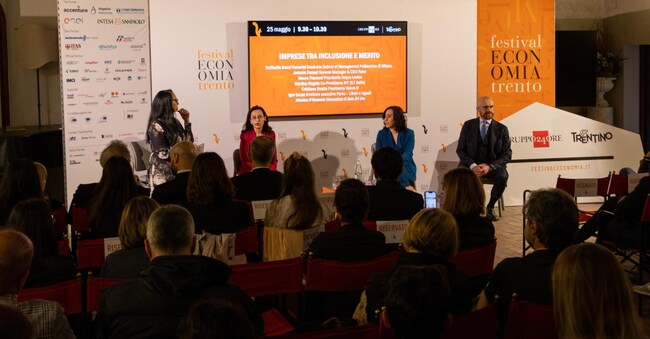
."Today, four generations coexist within organisations. The Z generation,' observed Cristiana Scelza, president of Valore D, during the round table entitled 'Enterprises between inclusion and merit', 'is exerting a strong gravitational pull on the other generations within organisations, particularly on how they judge work. This translates into a profound rethinking that starts with the meaning of the occupation one performs and the values of the company one is part of. And still on the subject of young people, Scelza emphasises that we can no longer afford the luxury of excluding talent on the grounds of prejudice, given the scarcity of supply on the labour market, and for this reason it is necessary to work on the biases that influence the assessment of performance and therefore of merit.
Lgbtq+
On the same wavelength was the speech by Igor Suran, executive director of Parks - Free and Equal, who emphasised: 'We need to create the conditions so that everyone can express their potential to the full and this can only be done by respecting the needs of each individual'. So the culture of listening and speaking out become indispensable for building a working environment that is open to diversity, because 'as companies we can do a lot to complete the Italian legal framework, on issues such as gender transition or homogenous parenthood'.
The certification of parity
.On the other hand, the Italian legislative panorama is not uniform and while it presents peaks of excellence, such as the law on gender quotas in corporate bodies, which has made Italy one of the most virtuous countries in the world in terms of the presence of women on the boards of directors of listed companies, on other fronts it still leaves something to be desired, as Martina Rogato, W7 co-president, pointed out: "Equality certification for companies is being looked at with attention by other countries, such as France, which would like to introduce it. At the same time, new challenges are coming from the European Union, which has just approved the Corporate Sustainability Reporting Directive, because companies will have new obligations to identify and mitigate damage not only in terms of the environment but also of human rights violations along the entire value chain".
Multiculturalism
.Companies, for their part, seem to be ready to face an ever-changing social complexity, as Mauro Franzoni, president of Acqua Levico, testifies: 'If in Italy immigrants represent 10 per cent of the population, in our company the percentage is double. In this sense, companies can be an element of cultural change, but they must demonstrate credibility in deeds towards all their stakeholders'. And Acqua Levico also does this by stopping activities to dedicate days to multicultural training.


