
Company fleets: the plug-in hybrid is a winner, offering both efficiency and freedom of movement

There is a common need shared by motorists, professionals and businesses: to opt for more efficient and sustainable mobility without changing their habits. To get around town whilst enjoying the benefits of electric propulsion, to reduce fuel consumption and emissions, whilst retaining the freedom to undertake a long journey without worrying about the remaining range. It is in meeting these needs that plug-in hybrid technology finds its compelling rationale. A solution capable of supporting the energy transition without compromising on practicality.
The principle is clear: combining an electric motor, powered by a rechargeable battery that can also be charged via an external socket, with an internal combustion engine. These two systems allow the car’s operation to be adapted to the conditions of use and to different driving requirements. On urban journeys and for commuting between home and work – which are a regular part of daily life – you can travel in electric mode, enjoying a quiet ride with zero tailpipe emissions. When travelling longer distances, the flexibility of the internal combustion engine comes into play, allowing you to continue your journey without relying on the availability of charging infrastructure.
It is also a practical solution to so-called ‘range anxiety’ – the concern about driving range that is holding back the uptake of fully electric cars. With a plug-in hybrid, the issue takes on a different perspective: electricity becomes the preferred power source, whilst the conventional engine ensures continuity. To fully reap the benefits, however, it is important to recharge the battery regularly. This makes the technology particularly attractive for those who have access to a charging point at work, at home or nearby – as is increasingly common in towns and cities.
This reasoning takes on particular significance in the world of vehicle fleets. For companies and fleet managers, the choice of a car does not depend solely on the purchase price, but also takes into account fuel consumption, running costs, operational requirements and user satisfaction. A car capable of covering most of its usual journeys on electric power, whilst retaining the versatility needed for business trips and out-of-town appointments, can make corporate mobility more efficient. Not to mention the value of sustainability in business strategies and the potential tax benefits associated with electric vehicles.
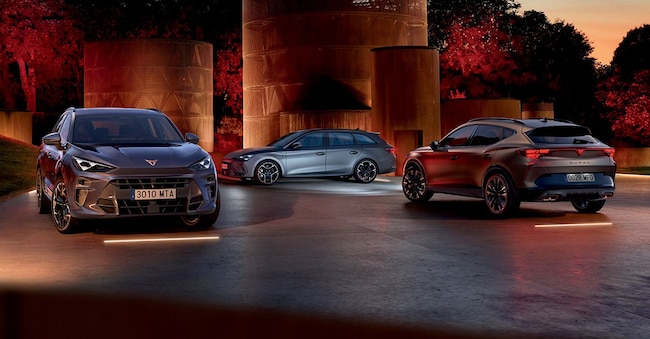
CUPRA, the Spanish brand that makes the fusion of innovation, design and performance a defining feature of its identity, offers a wide range of solutions for the new era of corporate mobility. The e-HYBRID range showcases plug-in technology across four models – the Formentor, the Terramar, the Leon family and the Leon Sportstourer – all featuring next-generation powertrains and a commitment to combining energy efficiency with driving pleasure.
Among these, the CUPRA Formentor is the model that, more than any other, has helped define the brand’s identity. In the e-HYBRID version, it delivers up to 272 CV, whilst the 204 CV version offers a range of up to 126 kilometres in 100% electric mode and a total range of up to 860 kilometres. These figures demonstrate the car’s ability to balance everyday use with longer journeys, without compromising on its sporty character, high-tech interior or distinctive design.
The same philosophy characterises the CUPRA Terramar, a sporty SUV that meets the needs for space, comfort and versatility through plug-in technology. The 204 and 272 CV powertrains are paired with a claimed electric range of up to 118 kilometres, whilst the driver-oriented cabin incorporates advanced digital solutions, from the Virtual Cockpit to the augmented reality head-up display. These features confirm that electrification can coexist with an engaging driving experience.
Rounding off the range is the CUPRA Leon, available in hatchback and Sportstourer body styles, with 1.5 e-HYBRID engines delivering 204 and 272 CV, and a claimed electric range of up to 134 kilometres. This range allows for numerous daily journeys to be made without resorting to the internal combustion engine. DC fast charging up to 50 kW increases flexibility. Furthermore, in the Sportstourer version, the boot capacity of up to 470 litres adds practicality for business use.
It is not simply a matter of choosing a different powertrain. Corporate mobility is also becoming a tool for attracting and retaining talent, particularly among younger generations who value technology, connectivity and the quality of the in-car experience. This is a vision that CUPRA has reinforced through its international campaign ‘The Chosen One’ featuring Tom Felton, inspired by an iconic scene from the first Harry Potter film.
The challenge of the energy transition does not necessarily lie in imposing a single solution on diverse needs, but in making technologies available that can adapt to real life. And it is precisely this capability that represents the strength of the plug-in hybrid: electric when needed, flexible when required, without forcing the driver to choose between sustainability and freedom of movement. A formula which, in CUPRA’s e-HYBRID range, also finds a practical application for the future of corporate fleets.

