The case

Leonardo helps companies expand business with advanced data analysis

Key technologies to push the boundaries of defence and aerospace

by Antonio Larizza

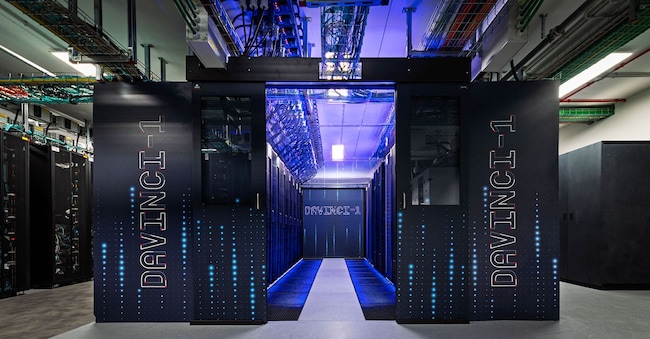
Il supercomputer Davinci-1 di Leonardo, in funzione nella sede di Genova

4' min read

Translated by AI
Versione italiana

Key points

  • Leonardo's transformation
  • Beyond the boundaries of defence

4' min read

Translated by AI
Versione italiana

In terms of size, complexity and industrial capacity required, the most advanced test launched in Italy involving the combined use of supercomputing and artificial intelligence is underway in the defence sector. It is called 'Michelangelo Dome' and is being conducted by Leonardo.

By exploiting big data, predictive algorithms, large proprietary language models, neural networks, generative artificial intelligence, high-performance computing, remote command and control systems and intelligent sensors located on ships, aircraft, satellites and ground infrastructure, Italy's leading defence and aerospace company has designed a 'security dome' capable of detecting, tracking and neutralising old and new threats. From attacks conducted by aircraft or missiles - including hypersonic missiles and swarms of drones - to those launched by sea or land, to hybrid attacks launched from the digital world. 'Michelangelo Dome' is programmed to anticipate enemy moves, optimise response times and automatically identify the most effective countermeasures. And thus enhance European and NATO countries' defence capabilities.

Loading...

'This project,' explains Simone Ungaro, Co-general manager strategy & innovation at Leonardo, 'constitutes the integrated air defence system we are developing as part of multi-domain solutions. It is a challenge that requires infinite computational and artificial intelligence capabilities to support command and control platforms. The system,' Ungaro continues, 'has to exchange huge amounts of data in real time, analyse them and turn them into immediate operational decisions. That is why we are working to bring computing power not only into our data centres, but also into sensors, on board ships and aircraft, on satellites, and on every active defence system in the field'.

Leonardo's transformation

There are two key technologies that Leonardo has at its disposal to tackle this new, complicated industrial challenge. Artificial intelligence and supercomputing. The company has been able to take up the challenge thanks to as many strategic infrastructures at its disposal: the Davinci-1 supercomputer - capable of performing 5 million billion operations per second - and the Leonardo innovation Labs, technological hubs created to do research and development on frontier technologies. Two levers present in Leonardo thanks to a visionary process of corporate transformation launched in 2019 by the current CEO Roberto Cingolani, which has changed the face of the company forever. Today, 200 employees are dedicated to the development of the supercomputing infrastructure. While more than 2,000 are already accessing the Davinci-1 for engineering simulations, AI-based predictive analysis, satellite image studies and the development of new technologies.

Installed in Genoa, the Davinci-1 supercomputer will soon be upgraded. The company will soon inaugurate the Davinci-2, which will have 30 petabytes of memory and 20 Petaflops of computing power. Power increases to 1.2 Exaflops for 8-bit operations, those typical of AI applications. 'Around this ecosystem that combines computing power, cloud resources and artificial intelligence,' Ungaro explains, 'Leonardo has developed distinctive skills. It is no coincidence that we are part of the shortlist of companies that have finalised the Italian proposal for the assignment of one of the five AI Gigafactories that the EU wants to build'.

Beyond the boundaries of defence

In this context, the Leonardo hypercomputing continuum (LHyC) business line was born about a year ago. It is, ideally, the building block that completes the transformation process started in 2019. With this move - with which Leonardo expects to earn EUR 230 million over the 2025-2029 business plan - the company is projecting its action beyond the boundaries of defence and aerospace. The aim is to also offer customers in other sectors - such as pharmaceuticals, climate science, finance, insurance, healthcare, automotive, weather forecasting - the possibility of using supercomputing and artificial intelligence to innovate processes, services and products by being able to count on full control of data, algorithms and computing infrastructure.

'The sovereignty of artificial intelligence is a central aspect of our proposal,' explains Greta Radaelli, Head of advanced cognitive solutions at Leonardo. Technological sovereignty is a topic that is becoming increasingly crucial, even outside the boundaries of defence. There is a growing awareness among companies that with artificial intelligence tools they are delegating and relinquishing control over important aspects of the business, much more so than with the introduction of the cloud. 'With regard to this crucial aspect,' explains Radaelli, 'we are able to guarantee our customers full control over the operating logic and responses provided by AI algorithms. Customers can know at all times what the machine is doing and how their data is being processed and managed'.

Sovereign Service Portfolio

The alternative developed by Leonardo to the 'IA black boxes' offered on the market by big tech is articulated on three levels. The most complete solution is the 'on-premise' one. In this case, Leonardo acts as a system integrator: it designs, installs and optimises a supercomputer directly on the customer's premises. The computing infrastructure is supplied on a turnkey basis, for an investment that starts at a few tens of millions of euros and grows according to the computing power and software services required.

The 'as-a-service' mode, on the other hand, provides part of the supercomputing capacity of the Davinci-1 and soon of the Davinci-2 within a dedicated 'private computing cloud', with infrastructure hosted in Italy or in EU countries. The cloud environments are managed by Leonardo using the same methodologies with which it operates in the military environment, so security levels comply with European standards and NATO guidelines. Computing resources are allocated on-demand, ensuring flexibility and controlled costs. Finally, with the 'enabling cognitive solutions' service, Leonardo provides customers with a specialised team for the development of artificial intelligence models to be applied to company data to improve decision-making and strategic processes.

The aim is to enable companies to transform themselves, as Leonardo has done, by exploiting the combination of supercomputing and artificial intelligence. But also to ensure that the unique skills gained in the defence sector have positive spin-offs in civil contexts, generating value and bringing progress in other areas of society. As has already happened in the past.

Copyright reserved ©
Loading...

Brand connect

Loading...

Newsletter

Notizie e approfondimenti sugli avvenimenti politici, economici e finanziari.

Iscriviti